41290
Person typing on a laptop

Learn

Home Stock in Focus – Bollore SE
April 28, 2026

Stock in Focus – Bollore SE

Jordan Lipson, Portfolio Manager, Cromwell Phoenix Global Opportunities Fund


Cromwell Jordan Lipson Portfolio Manager

The Bollore Galaxy – An Update

As many readers may be aware, the portfolio has long held an exposure to entities controlled by the Bollore Family. The portfolio’s largest holding is Compagnie de l’Odet (Odet), a French-listed holding company controlled by the Bollore’s. Past generations of Bollore’s were in the business of thin paper manufacturing for uses such as rolling tobacco. In the 1980’s Vincent Bollore was an investment banker. He saw that the old family business was struggling mightily and decided to acquire the distressed business and recapitalise it. Bollore needed to raise external capital to diversify the company’s business interests but wanted to maintain operational control. Like any good investment banker, Bollore achieved this through complex structuring.


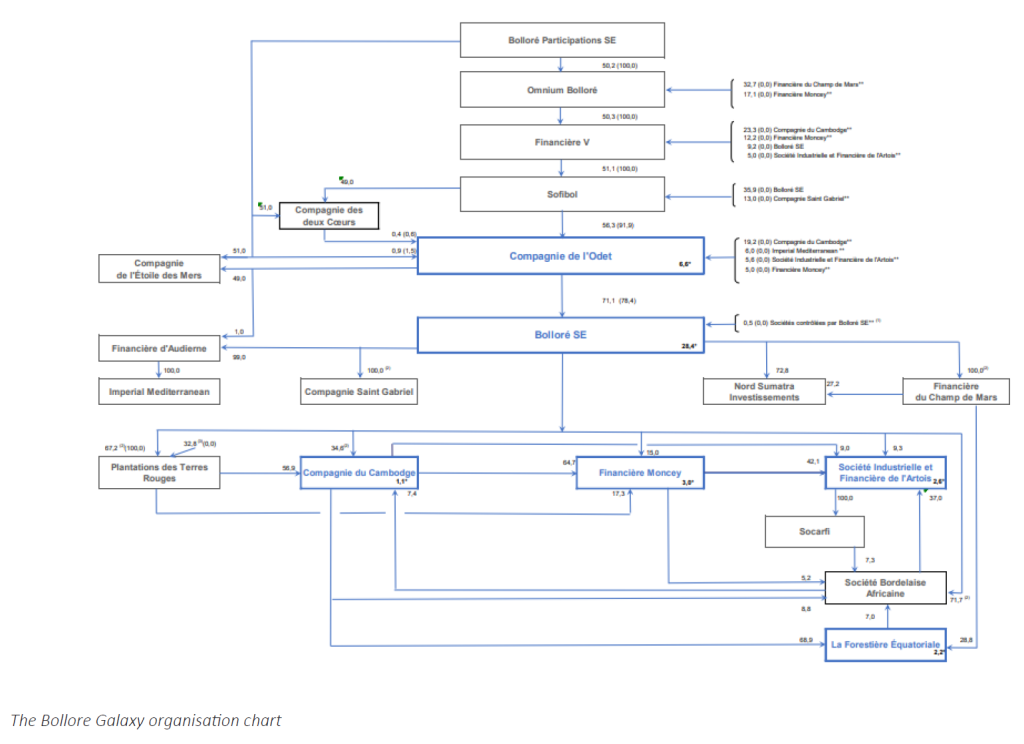
The current organisational chart is presented below to demonstrate this complexity, but for the sake of this article there are two key entities, both listed in France. They are:

  • Compagnie de l’Odet (Odet)
  • Bollore SE

These two companies own meaningful stakes in each other, creating an “ownership loop”. This structure can make the group difficult to analyse at first glance and importantly obscures the true value of the underlying assets.


org chart

Simplicity hidden by complex structure

Once one picks through the complex structure, understanding the underlying assets owned by both Bollore SE and Odet is relatively simple.

Odet predominantly derives its value from its stake in Bollore SE, while Bollore SE owns:

  • 5.6 billion euros in net cash (mostly raised through the timely sale of its logistics business at the top of the cycle)
  • An 18.4% stake in Amsterdam-listed Universal Music Group (UMG), the world’s largest music publisher
  • Smaller media and other investments (Including Vivendi)


Some action towards discount closure

At period end, valuing UMG at its prevailing share price, Odet’s net asset value is more than 280% above its share price (not a typo!). As such, nirvana for Odet’s external investors has always been the prospect of simplification of the corporate structure and perhaps assets being distributed, so that the discount is captured (ignoring any tax complexities). The actions of Vincent Bollore have always been unpredictable. To date, steps towards simplification have been erratic and incremental, however the direction of travel has broadly been positive. Bollore SE and Odet released their annual results during the period. Given the simple nature of the underlying assets, the results held very few surprises. The one major surprise was the announcement that Bollore SE would pay a special dividend of 1.50 euros per share, which represented more than one third of Bollore SE’s share price at the time of announcement. Furthermore, Odet announced that it would pay out two thirds of the dividend it received to its shareholders.

A special dividend is particularly important to holding companies trading at discounts to their NAV. When a holding company trades at a discount, investors are essentially buying $1.00 of underlying assets for a lower price, such as $0.50. A special dividend unlocks this “trapped” value because every dollar distributed is paid out at 100% of its worth, allowing shareholders to realize the full value of the assets regardless of the stock’s discounted market price. Odet’s share price rallied on the dividend news, but after one ascribes full value to thespecial dividend payment, the discount to NAV has actually widened.

In essence, the vast majority of Odet’s value is driven by cash and its indirect holding in UMG.

“At period end, valuing UMG at its prevailing share price, Odet’s net asset value is more than 280% above its share price (not a typo!)”

The UMG conundrum

Music has proven to have universal appeal (excuse the pun) across all ages and regions. UMG is the world’s largest music publishing business, having represented 9 of the top 10 artists globally across each of the past three years, including Taylor Swift and Lady Gaga. For readers of a different generation, UMG also owns timeless assets such as rights over The Beatles back catalogue. UMG can be thought of as a toll booth on music consumption.

Since its separate listing in 2021, UMG has typically traded at a premium valuation, given the high-quality nature of its business. Very recently, concern has grown that artificial intelligence (AI) may threaten the quality of this business, both by enabling solo artists to self-publish and by allowing AI to create the music itself. This threat has caused UMG’s share price to drop from a high of almost 29 EUR per share to lows of approximately 15.50 EUR per share. According to S&P CapitalIQ consensus estimates, UMG trades at a 2026 Price to Earnings ratio less than of 16x, which compares to the S&P 500’s price to earnings ratio of just under 26x.

The quality of the music business has been tested before. Physical sales of music, mostly CDs, peaked in 1999. The proliferation of music piracy meant that it took until 2021 for music sales to reach that absolute level again (see below). Adjusted for inflation, music sales are still below that 1999 level.
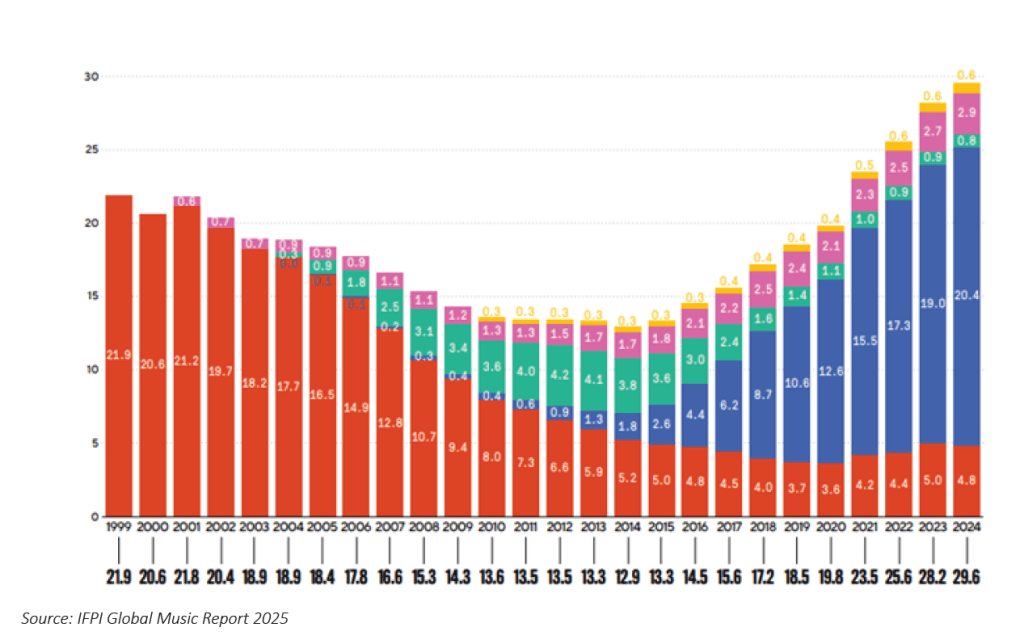
music-report

Streaming services, and their global appeal completely changed the game for musicians and publishers. UMG’s more bullish investors would say that these streaming services have pricing power beyond what they currently charge and are also supported by the tailwind of a growing global middle class that can afford these services. If this is true it would likely mean robust earnings growth for the company for many years to come. UMG’s detractors would say AI developments will take power away from music publishers and extreme believers in AI would say it takes relevance away from the skill and creativity of musicians and songwriters.

Should concerns turn out to be overblown and UMG once again trades at its previous highs, Odet’s NAV would expand to a ~370% premium to its current share price! Alternatively, even assigning zero value to UMG leaves Odet’s NAV at a ~65% premium to the prevailing share price, showing the high margin of safety inherent in this investment. While there are legitimate debates about the future of music, we believe the long-term appeal of professionally produced content remains strong. However, an investment in Odet could still be an excellent investment, even if that belief proves to be optimistic.


The Longer Game

The ultimate result for investors would be a return to glory for UMG, alongside a return of capital from Odet. In recent times, the number of boxes in the organisational chart above has reduced as some simplification has occurred. The Bollore Family has also tried to remove more entities from that chart, yet faced resistance from minority shareholders. Odet itself has bought more and more Bollore shares. This activity (which effectively amounts to a buyback) has accelerated since the entities released their full year results. Most importantly, the recently announced special dividend shows a willingness to return capital to external shareholders and also moves cash around the different entities within the Bollore Galaxy. This may be tactical and act as a prelude to Vincent Bollore’s next move. Possibilities are the basis of much speculation amongst shareholders, but only the Bollore’s know the true endgame. In the short term the distribution allows shareholders to receive a meaningful portion of the NAV back at 100 cents on the dollar. Not a bad outcome for now.


Cromwell Global Opportunities Fund Performance

For more in-depth performance commentary on select undervalued international securities, sign up to the Cromwell Global Opportunities Fund quarterly update!