

43177
Person typing on a laptop

Learn

Home Commercial Property and Portfolio Considerations After the Reset 
September 28, 2026

Commercial Property and Portfolio Considerations After the Reset 

As the market moves beyond repricing, commercial property is shifting from a recovery story to a portfolio construction opportunity. 

For much of the past three years, commercial property has been defined by a familiar set of concerns: rising interest rates, falling valuations, and weaker transaction activity. 

For advisers working with High Net Worth and Ultra High New Worth (HNW and UHNW) clients, these were important issues to consider when assessing portfolio allocations and risk exposure. But markets rarely stand still. 

The focus today has shifted beyond whether commercial property can recover. In many sectors, the adjustment has already occurred, with valuations repriced to a higher-rate environment and many of the concerns that dominated investor thinking over recent years already reflected in asset values. 

As markets move beyond the reset, the key consideration for investors is where improving fundamentals, future income growth, and changing supply-demand dynamics are creating new opportunities. 
Array
(
    [slides] => Array
        (
            [0] => Array
                (
                    [media_type] => image
                    [image] => Array
                        (
                            [image] => Array
                                (
                                    [ID] => 43426
                                    [id] => 43426
                                    [title] => banner_raytheon
                                    [filename] => banner_raytheon.jpg
                                    [filesize] => 332017
                                    [url] => https://www.cromwell.com.au/wp-content/uploads/sites/2/2026/09/banner_raytheon.jpg
                                    [link] => https://www.cromwell.com.au/commercial-property-and-portfolio-considerations-after-the-reset/banner_raytheon/
                                    [alt] => 
                                    [author] => 8
                                    [description] => 
                                     => 
                                    [name] => banner_raytheon
                                    [status] => inherit
                                    [uploaded_to] => 43177
                                    [date] => 2026-09-18 01:56:31
                                    [modified] => 2026-09-18 01:56:31
                                    [menu_order] => 0
                                    [mime_type] => image/jpeg
                                    [type] => image
                                    [subtype] => jpeg
                                    [icon] => https://www.cromwell.com.au/wp-includes/images/media/default.png
                                    [width] => 2000
                                    [height] => 1334
                                    [sizes] => Array
                                        (
                                        )

                                )

                            [alternate_images] => 
                            [mobile_image] => 
                            [tablet_image] => 
                        )

                     => Array
                        (
                            [video_type] => file
                            [autoplay] => 
                            [video_file] => 
                            [video_embed] => 
                            [image_placeholder] => Array
                                (
                                    [image] => Array
                                        (
                                            [image] => 
                                            [alternate_images] => 
                                            [mobile_image] => 
                                            [tablet_image] => 
                                        )

                                )

                        )

                    [title_block] => Array
                        (
                            [title] => 
                            [emphasise_title] => 
                            [emphasised_text] => real foundations.
                            [emphasis_style] => script
                            [content] => 
                        )

                    [text_width] => constrained
                    [button_group] => Array
                        (
                            [buttons] => 
                        )

                    [button_alignment] => left
                    [button_direction] => horizontal
                )

        )

    [banner_placement] => inner
    [media_position] => full
    [full_height] => banner-short-height
    [banner_logo] => 
    [content_alignment] => left
    [block_theme] => Array
        (
            [block_theme] => Array
                (
                    [] => 
                    [background_colour] => theme-white
                    [block_padding] => section-padding-small
                    [add_anchor_id] => 
                    [anchor_id] => 
                )

        )

)

What does this mean for client portfolios?

The reset has created a timely opportunity to reassess the role unlisted commercial property could play alongside listed markets and other private assets. Five portfolio implications stand out:

  1. Relative positioning: unlisted property has already been repriced to a higher-rate environment, while some listed markets continue to rely on future growth expectations.
  2. Income durability: for clients seeking reliable cash flow, the quality and sustainability of income matter as much as the headline yield. Tenant quality, lease terms and the ability of an asset to remain useful over time influence the resilience of property income through changing market conditions.
  3. Diversification: institutional-quality property can provide exposure to different return drivers from listed equities, but the benefit depends on the underlying assets and structure.
  4. Sector selection: office, industrial and retail are at different points in their cycles, highlighting the importance of understanding sector-specific drivers and market dynamics.
  5. Access and structure: listed property securities, direct property, unlisted trusts and specialist strategies offer different combinations of liquidity, control, diversification and investment horizon.

For some clients, listed property securities may provide the desired exposure. For others, direct property, unlisted trusts or specialist real estate strategies may be more appropriate especially when tax considerations are factored in.

The important point is that commercial property is increasingly being assessed not only on what happened during the correction, but on where opportunities may exist going forward.

Different asset classes, different stages of the cycle

One of the more notable features of the current investment environment is the divergence between asset classes. 

Many listed equity markets continue to trade near historical highs, supported by strong earnings expectations and investor confidence, while commercial property, by contrast, has already experienced a substantial repricing. 

For advisers, this creates an important portfolio construction consideration. 

Clients will benefit from reassessing how portfolios are positioned when one asset class has already adjusted to a new interest-rate environment while another continues to be valued on future growth expectations. 

This consideration sits against a broader backdrop in which proposed changes to capital gains tax are prompting investors to reassess the balance between income and growth within their portfolios.

Related reading

Commercial property has already repriced, while equity markets remain supported by future growth expectations.


This is not an argument for reducing exposure to equities. It is a prompt to reconsider portfolio positioning when asset classes have moved through the cycle at different speeds. 

With both markets and policymakers challenging growth-based investment strategies, the case for assets supported by income and underlying fundamentals is becoming harder to ignore. 

Array
(
    [slides] => Array
        (
            [0] => Array
                (
                    [media_type] => image
                    [image] => Array
                        (
                            [image] => Array
                                (
                                    [ID] => 42361
                                    [id] => 42361
                                    [title] => creek_banner_01
                                    [filename] => creek_banner_01.jpg
                                    [filesize] => 530476
                                    [url] => https://www.cromwell.com.au/wp-content/uploads/sites/2/2026/07/creek_banner_01.jpg
                                    [link] => https://www.cromwell.com.au/?attachment_id=42361
                                    [alt] => 
                                    [author] => 8
                                    [description] => 
                                     => 
                                    [name] => creek_banner_01
                                    [status] => inherit
                                    [uploaded_to] => 42332
                                    [date] => 2026-07-11 10:18:50
                                    [modified] => 2026-07-11 10:18:50
                                    [menu_order] => 0
                                    [mime_type] => image/jpeg
                                    [type] => image
                                    [subtype] => jpeg
                                    [icon] => https://www.cromwell.com.au/wp-includes/images/media/default.png
                                    [width] => 1800
                                    [height] => 500
                                    [sizes] => Array
                                        (
                                        )

                                )

                            [alternate_images] => 
                            [mobile_image] => 
                            [tablet_image] => 
                        )

                     => Array
                        (
                            [video_type] => file
                            [autoplay] => 
                            [video_file] => 
                            [video_embed] => 
                            [image_placeholder] => Array
                                (
                                    [image] => Array
                                        (
                                            [image] => 
                                            [alternate_images] => 
                                            [mobile_image] => 
                                            [tablet_image] => 
                                        )

                                )

                        )

                    [title_block] => Array
                        (
                            [title] => 
                            [emphasise_title] => 
                            [emphasised_text] => real foundations.
                            [emphasis_style] => script
                            [content] => 
                        )

                    [text_width] => constrained
                    [button_group] => Array
                        (
                            [buttons] => 
                        )

                    [button_alignment] => left
                    [button_direction] => horizontal
                )

        )

    [banner_placement] => inner
    [media_position] => full
    [full_height] => banner-short-height
    [banner_logo] => 
    [content_alignment] => left
    [block_theme] => Array
        (
            [block_theme] => Array
                (
                    [] => 
                    [background_colour] => theme-white
                    [block_padding] => section-padding-large
                    [add_anchor_id] => 
                    [anchor_id] => 
                )

        )

)

Not all property sectors are moving together 

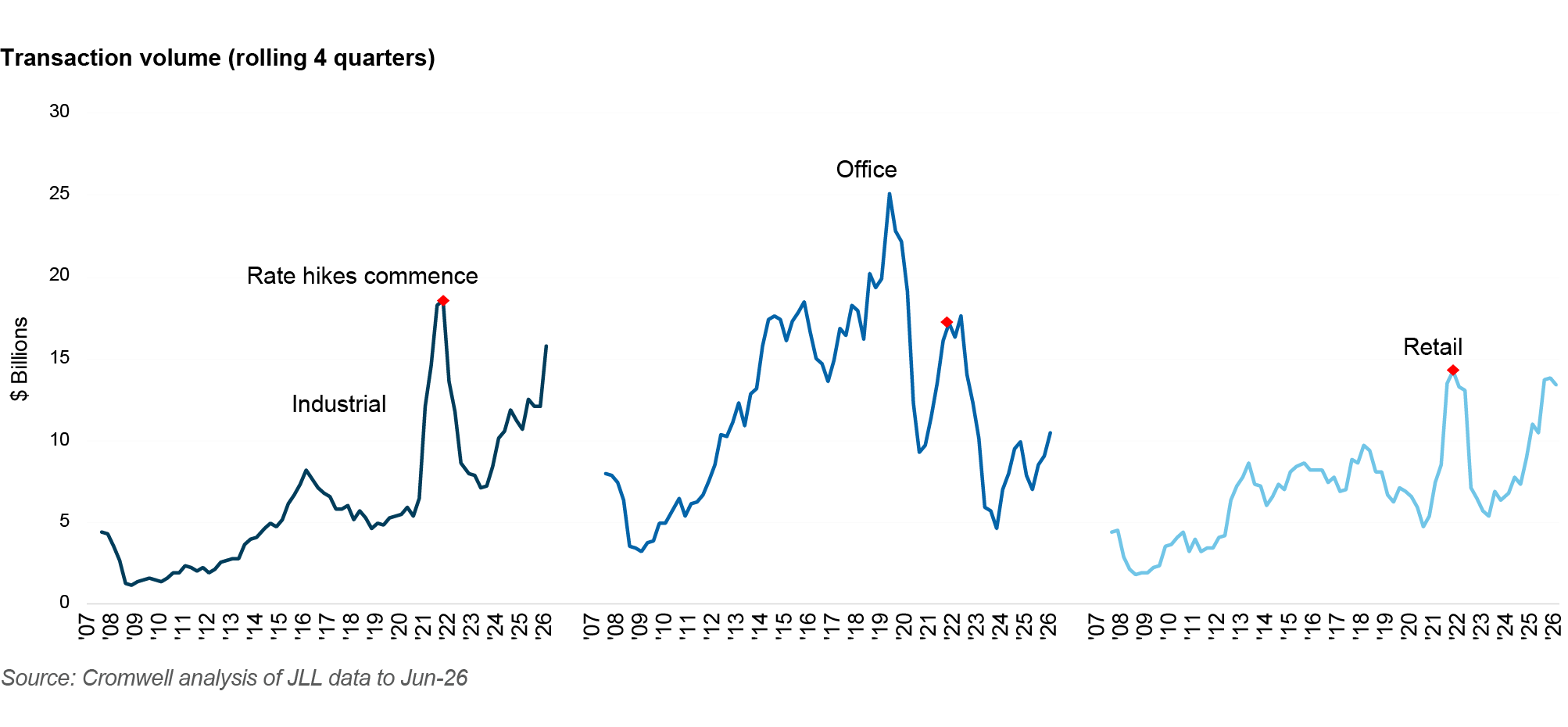
Office, industrial and retail are shaped by different demand drivers, supply settings and tenant behaviours. Higher rates affected values across the market, but future performance is increasingly likely to be determined by sector and asset-level fundamentals. 

Sector selection matters more as market conditions diverge. 


Office: looking beyond the old narrative 

Few sectors illustrate changing market narratives better than office. 

For several years, office property was largely discussed through the lens of declining values, hybrid work and structural uncertainty. Yet a number of those concerns have, in our opinion, already been reflected in pricing. 

At the same time, several major CBD markets and individual assets have experienced improving tenant demand, rising rents and increasingly constrained future supply, driven in part by elevated construction costs.  

In our view, the opportunity in office is no longer about waiting for recovery. It is about owning well-located, high-quality assets in supply-constrained markets where rental growth and increasing tenant demand are already supporting fundamentals. 

Retail: separating perception from performance 

Retail property shows how sector-wide predictions can overlook what is happening at the asset level. E-commerce, changing consumer behaviour and weaker sentiment created genuine pressure, but the impact was uneven. Investor interest has since returned to parts of the market, particularly assets supported by population growth, tenant demand and a strong customer offering. 

In our view, the best retail assets have already won the structural battle against e-commerce, with their value increasingly driven by location, convenience and experience rather than online competition. 

Industrial: from growth tailwinds to asset selection 

Industrial property presents a different challenge and opportunity. 

Unlike office and retail, industrial benefited from powerful structural tailwinds throughout and immediately after the pandemic, including e-commerce growth and supply-chain reconfiguration. The sector is now moving into a more mature phase of the cycle. 

In our view, while the period of rapid valuation uplift may have plateaued, industrial continues to offer some of the strongest fundamentals in commercial property, supported by tenant demand, rental growth and limited availability in key markets. 

Final Thought

The strongest opportunities after a correction rarely come from making a single call on an entire asset class. They come from identifying where price, income and operating fundamentals are moving into better alignment. In an environment where outcomes are increasingly being driven by asset selection rather than broad market exposure, the capability of the investment manager is just as important as the sector itself. For advisers and their clients, that means looking beyond asset class labels and focusing on managers with a demonstrated track record of selecting, managing and creating value in real estate across market cycles. 

For a deeper discussion on sector-specific fundamentals or how different forms of property exposure may fit within a portfolio, speak with the Cromwell team. 

Important Notice

This material is prepared for discussion only and should not be relied upon for any other purposes. It has been prepared on a good faith basis but its contents have not been formally verified and no Cromwell entity or person accepts any duty of care to any person in relation to the information it contains. It should not be considered to be investment advice, marketing material or a promotion or offer of any Cromwell fund, product or services. Any person that wishes to invest in any Cromwell fund, product or services should refer to the relevant information or legal documents produced in relation to such opportunity before making any investment or other decisions. This document reflects the views of its author as at July 2026.