15450
Person typing on a laptop

Learn

Home Research
June 8, 2026

Artificial Intelligence and the Future of Office

Colin Mackay, Research & Investment Strategy Manager, Cromwell Property Group


Navigating the narrative

Artificial intelligence (AI) has rapidly become a central theme in economic and market discourse. Commentary is polarised, with extreme views often dominating. On one end, AI is framed as a transformative productivity breakthrough. On the other, it is an existential threat to white-collar work and society as we know it. The impacts of AI adoption remain highly uncertain, and a healthy dose of scepticism should be reserved for those confidently claiming prescience.

Regardless, it is important to assess the potential outcomes and consider how the outlook for the office sector may shift if the technology becomes more powerful, widespread, and integrated. Answering this requires separating signal from noise, grounding analysis in historical precedent, and focusing on the mechanisms through which technological change affects occupier behaviour.

In our view, AI is more likely to reshape the composition of office demand than to compromise it. For investors, the path forward will involve selecting markets and asset types which occupiers continue to favour.

“Consider thou what the invention could do to my poor subjects. It would assuredly bring to them ruin by depriving them of employment.”

Queen Elizabeth I, 1580s, in relation to the knitting machine.

Source: Why Nations Fail, Acemoglu, Robinson (2012)


Lessons from history

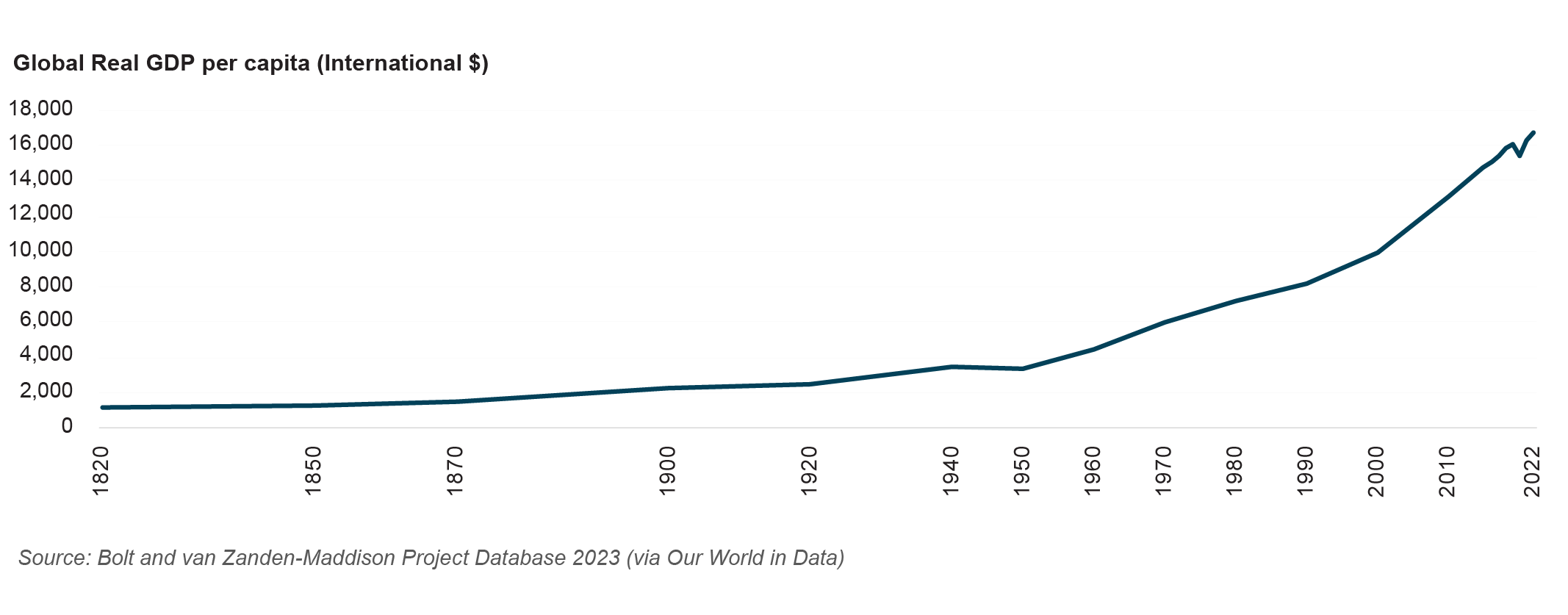
Technological advancement has been the driving force behind many of humanity’s biggest transformations, from mechanisation and electrification to computers and the internet. And through history, commentators have predicted the end of employment.


In reality, while labour displacement occurred through each technological transition, new forms of activity were also created. The pool of jobs expanded as previously inconceivable industries and occupations emerged over time, and productivity gains drove significant economic growth and higher living standards.

AI may be the modern driver of a similar dynamic. This time, the scarce resource isn’t physical output, but cognitive power: the capacity to analyse, synthesise, and solve problems. By reducing the cost of cognition-intensive tasks, AI may enable firms to undertake more analysis, pursue more opportunities, run more experiments, and serve more clients. As with earlier productivity-enhancing technologies, the effect may be expansionary rather than labour-saving.

Chart of Global Real GDP per Capita
Importantly, technology-driven transformations have often been disruptive at the micro level – affecting individual workers and firms – but constructive at the macro level. History suggests that while the composition of employment changes through technological advancement, the quantity increases. For office markets, the implication is that the primary risk is not the disappearance of work, but the reconfiguration of which industries and roles drive demand.

“The number of jobs lost to more efficient machines is only part of the problem. What worries many job experts is more that automation may prevent the economy from creating enough new jobs.”

Time Magazine, 1961

Source: Why Are There Still So Many Jobs? The History and Future of Workplace Automation

Signal or hallucination?

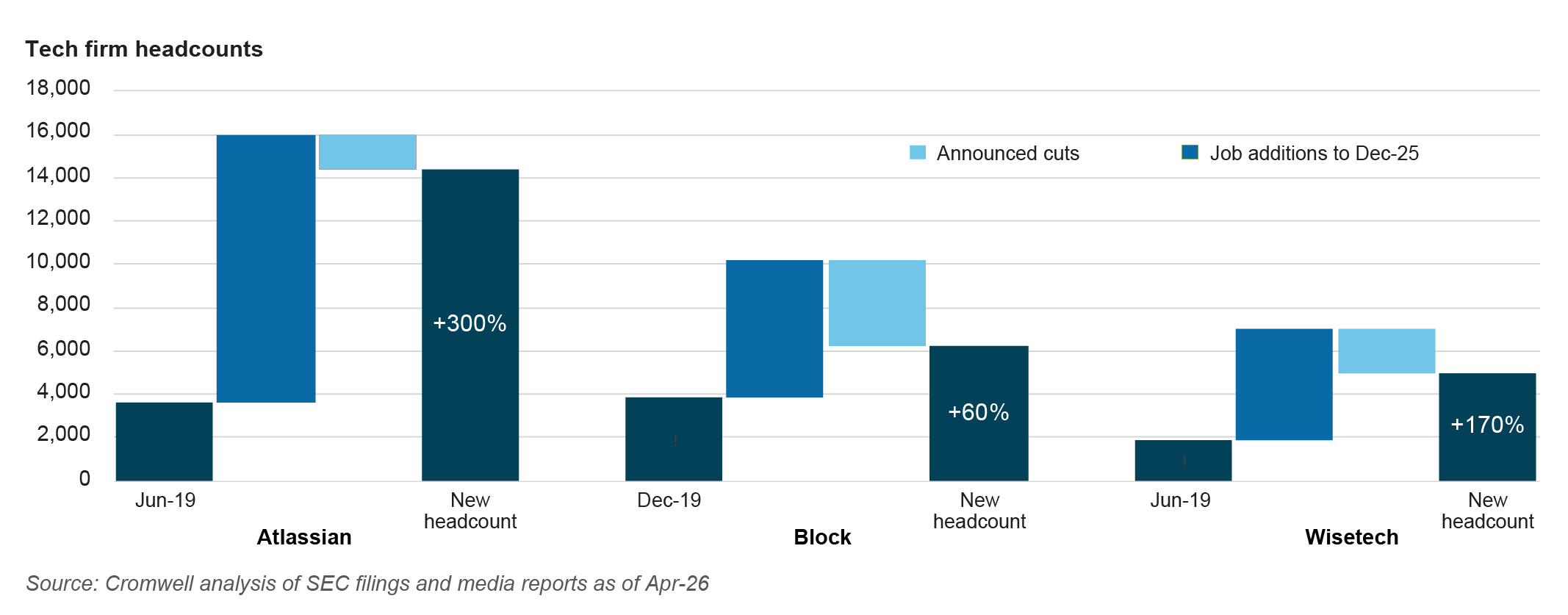
But is this time different? Recent headlines have linked AI to significant job cuts across technology firms such as Wisetech, Block, and Atlassian. However, these corporate announcements require context.

While workforce reductions appear significant, they follow a period of rapid hiring during the pandemic and post-pandemic recovery. In these high-profile cases, employment levels remain materially above pre-2020 baselines even after announced cuts, suggesting the contractions may reflect a ‘normalisation’ of headcount rather than AI impacts.


Chart of Tech Firm Headcounts for Atlassian, Block and Wisetech


Broader evidence of an AI-led employment contraction is limited. At the aggregate level, labour markets remain resilient with little indication of structural unemployment1. In the US, AI does appear to be having a negative impact on the employment outcomes of young people, particularly those entering the workforce2, in occupations most exposed to AI automation. However, occupations that are augmented by AI continue to record employment growth across demographics3. Overall, AI is currently more visible in narrative than in measurable labour market outcomes.

“Intelligent machines are replacing human beings in countless tasks, forcing millions of blue and white collar workers into unemployment lines.”

Jeremy Rifkin, 1995

Source: The End of Work

Base case: augmentation over automation

In our view, the most plausible base case is that AI functions predominantly as an augmentative technology rather than a wholesale substitute for human labour. Central to this conclusion are the incentives and constraints that shape real world economic behaviour.

Firms optimise for growth, not just cost

Businesses optimise not only for cost minimisation but for output quality, growth, resilience, and competitive position. AI can reduce the cost of specific tasks, but its economic value is often highest when combined with human judgement, oversight, and contextual understanding. In practice, this favours a complementary relationship where workers become more productive, decisions improve in quality, and the scope of activity expands.

This will not be a universal experience. Some businesses, particularly those under margin pressure, may use AI primarily to reduce headcount and extract cost rather than to expand. But that response often says as much about the condition of those businesses as it does about the technology itself. Businesses don’t shrink to greatness, and contraction by weaker operators may ultimately create room for stronger firms to invest, grow, and take share.

Automation thresholds will increase

Recent academic research highlights the importance of task quality in shaping how firms deploy automation4. AI is likely to be adopted first in tasks where it can meet existing output quality at low risk. As these lower-value or more routine tasks are automated, human effort is freed up and reallocated toward activities that are more judgement-intensive, relationship-driven or context-specific.

This reallocation improves the quality of the remaining human-led tasks: more time and focus = better output. The quality threshold AI must then reach is increased, making it harder for further automation to occur5. This self-reinforcing augmentation loop sees people focusing more and more on higher value activities, in turn increasing the value of their labour.

Full delegation introduces risks

While AI can enhance productivity across a range of tasks, the case for fully delegating long, complex, or high-stakes work remains less compelling. Microsoft research finds that as task length and complexity increase, AI output quality deteriorates and document contents can become corrupted6. Errors compound across steps, objectives can drift over time, and inconsistencies can be difficult to detect.

Similar issues are evident in software development and cybersecurity. AI-assisted coding tools can accelerate development, but fully delegated code generation has been shown to contain more security vulnerabilities than human-written code7.

These dynamics reinforce the ongoing importance of human oversight and limit the extent to which full automation can be deployed. While the technology will likely improve, it will take time and resources. Productivity gains are therefore likely to be uneven and may be slower to materialise than implied by some of the more optimistic claims.

High unemployment will not be allowed to persist

At a macro level, there are social, economic, and political limits to how long high unemployment can persist without response. South Korea (late 90s) and Spain (early 2010s) are useful modern examples: in both cases, severe labour market deterioration was accompanied by social strain, political pressure and, ultimately, policy adjustment.

Elevated unemployment and the dislocation that accompanies it tend to provoke institutional adaptation aimed at restoring labour market stability. For that reason, the more plausible outcome is slower, more adaptive adjustment rather than a sustained period of mass unemployment.


Downside case: weaker demand but no sectoral collapse

A more pessimistic scenario could arise if the pace of AI-driven disruption materially outstrips the economy’s capacity to adapt. Even in that case, however, the implications for office demand are unlikely to be linear.

A reduction in labour input doesn’t necessarily require a one-for-one fall in employment. Given society’s limited tolerance for sustained unemployment, weaker labour demand would more likely be absorbed through changes in working patterns than through mass job losses. One potential mechanism is a reduction in average working hours, such as the adoption of a four-day work week. This would adjust overall labour supply while avoiding a commensurate decline in employment.

For office markets, fewer hours worked wouldn’t necessarily translate into a proportional reduction in space demand. Offices, like stadiums, are typically configured to accommodate peak occupancy (e.g. anchor days) rather than average utilisation. And in a future where the human-centric elements of work such as collaboration, innovation, and culture-building become more important than the routine, having sufficient fit-for-purpose space will be far more important than maximising workplace density.

Supply dynamics would also act as a moderating force. Elevated construction costs, tighter financing conditions and feasibility constraints are already limiting new development, reducing the risk that weaker demand outcomes translate into structural oversupply. At the same time, ongoing population growth should continue to support aggregate economic activity and space needs over time, even if AI reduces labour intensity in some functions. Over time, the withdrawal or conversion of obsolete stock would provide further stabilisation.

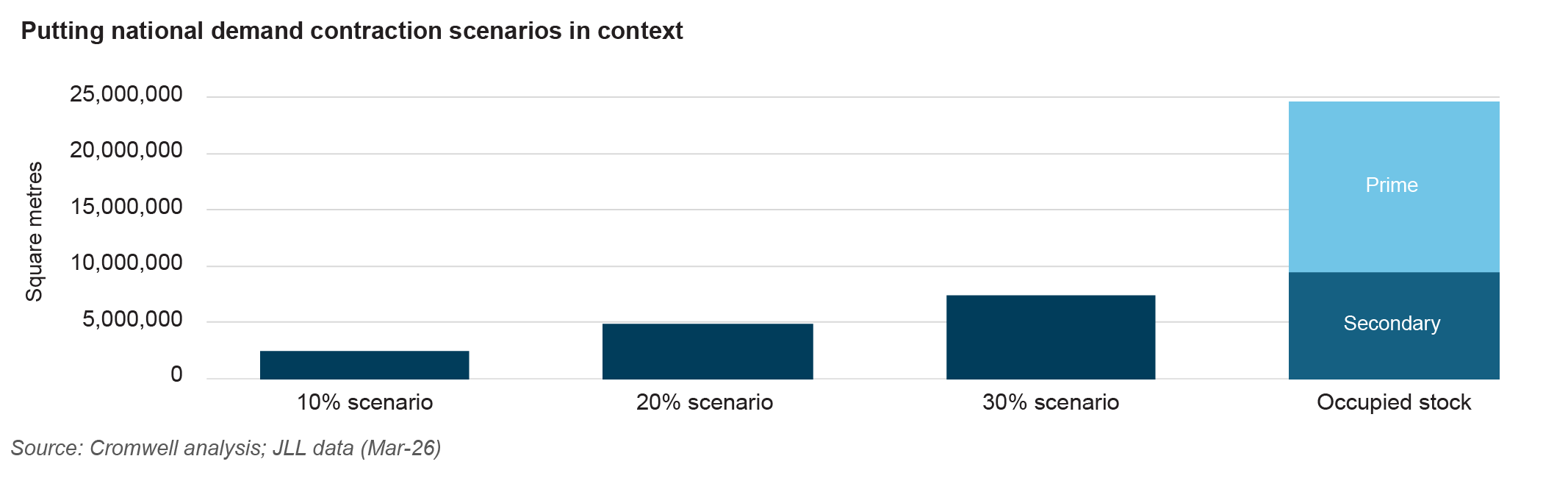
The chart below puts potential downside scenarios into context and illustrates that desirable stock (i.e. prime) should be relatively resilient even in the event of a severe reduction in demand. Flight-to-quality and the withdrawal of secondary assets from the market could, over time, wholly absorb a contraction in excess of 30%. Under such a scenario, investment outperformance would become increasingly dependent on asset selection and the alignment of building attributes and tenant experience with occupier needs.

 

“Most, if not all professional tasks…will be fully automated by an AI in the next 12-18 months.”

Mustafa Suleyman, Microsoft AI Chief Executive, 2026

Source: Interview with the Financial Times via Youtube

Implications for office markets

Employment and demand mix

Under our base case, the office-using workforce continues to grow in aggregate as productivity gains support economic expansion and population growth underpins underlying demand.

AI adoption is likely to be slower in parts of the economy where compliance, accountability and implementation constraints are more significant (e.g. government). The effects may also be slower to emerge in industries such as construction and manufacturing, where office-based roles are more closely tied to physical operations.

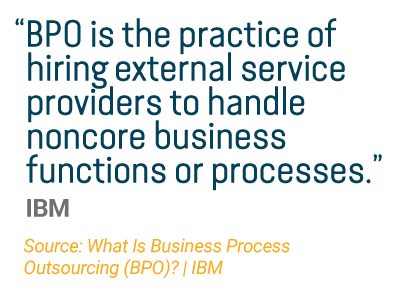
By contrast, back-office processing functions that are more standardised and repeatable face greater automation pressure. Even if these roles are materially disrupted, the impact on the broader Australian office market should be limited given the diversity of the domestic demand base. In some offshore markets, where these functions account for a larger share of demand, the effects could be more pronounced. In Metro Manila for example, the Business Process Outsourcing sector accounted for 64% of leasing demand in 20258.

Smaller occupiers, more fragmentation

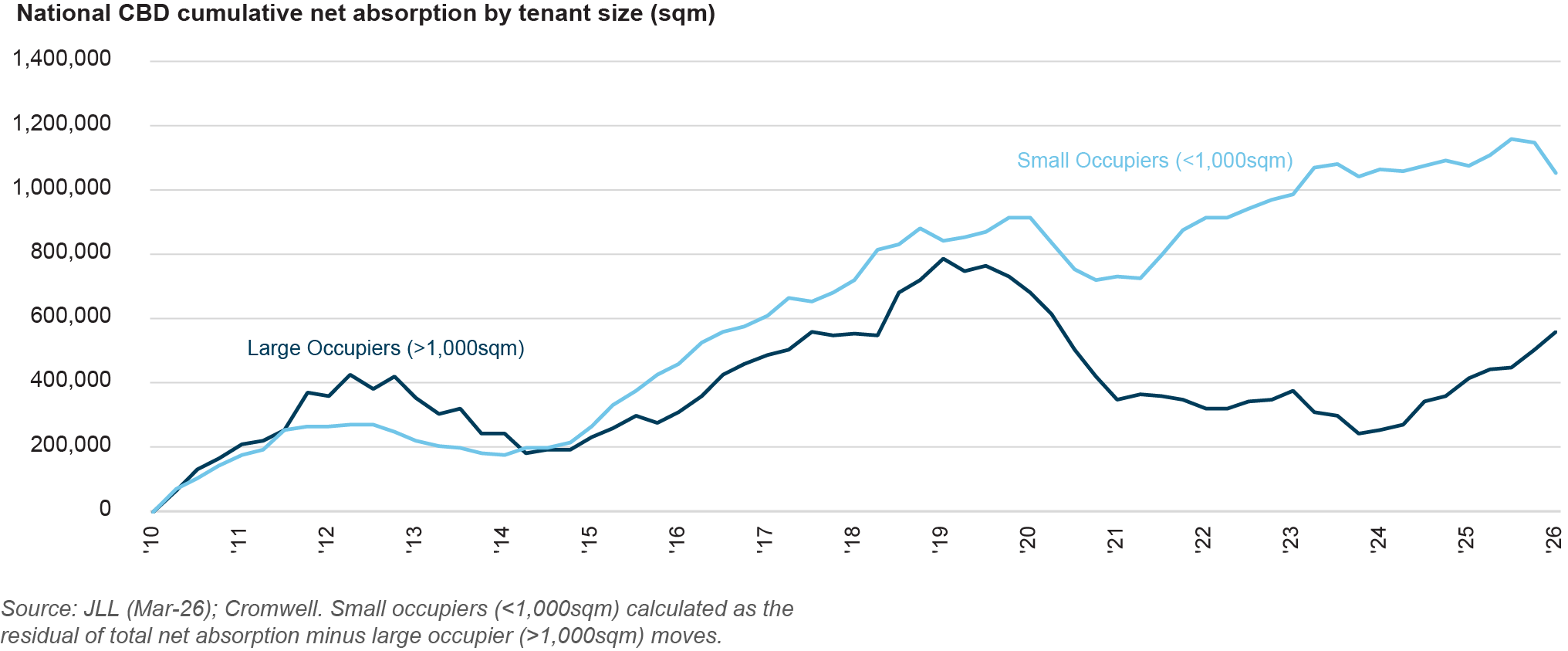
We believe AI may shift occupier demand toward smaller businesses and drive a more fragmented tenant base. Lower start-up costs and the emergence of new business models may encourage new entrants, while existing small and medium-sized enterprises are, in our opinion, more likely than large corporates to use productivity gains to support growth rather than bank the savings through cost-outs. That tendency partly reflects the more dynamic and multi-functional nature of roles within smaller organisations, which makes them less amenable to automation than the more process-oriented roles in larger firms.

Smaller occupiers are also far less able to hand back space or sublease part of their footprint, reducing the likelihood of short-term speculative contractions. This theme was evident during the pandemic and post-pandemic recovery, when smaller occupiers accounted for a greater share of net office demand and were more likely to expand than contract.

Across office markets, this would support greater demand for smaller, more adaptable floorplates that are better suited to this size of tenant, along with assets that offer attractive shared amenity such as boardroom facilities and collaboration spaces. It may also increase the value of flexible leasing structures and speculatively fitted suites, given smaller occupiers are less likely to have the internal resources to plan and deliver bespoke fitouts.


Space use and workplace design

Densification has been gradually occurring for decades, and we don’t expect AI to materially reverse or accelerate this trend. The more meaningful shift is likely to be in workplace design, as floorplates evolve away from desk-heavy layouts toward more meeting rooms, collaboration spaces, and shared amenity to support in-person interaction for complex and valuable work.

This may increase the importance of technology integration and bandwidth capacity within buildings, as occupiers place greater value on seamless connectivity and the ability to support more data-intensive ways of working. Similarly, greater reliance on AI-enabled workflows is likely to elevate data security and control considerations for some occupiers, shaping preferences toward buildings with secure, resilient technology environments.

Quality and market polarisation

These shifts are likely to make office demand less homogeneous. Firms will adopt AI at different speeds, in different ways, and with different workplace requirements. Buildings that can accommodate varied and evolving occupier needs, both through physical adaptability and management flexibility, should attract a greater premium.

Location and quality preferences are also likely to strengthen rather than weaken. High-skill, knowledge-based work will continue to benefit from agglomeration, reinforcing the role of major CBDs. As the office becomes more focused on enabling high-value work outcomes, fit-for-purpose space and proximity to key stakeholders are likely to become higher priorities relative to rent minimisation.

We expect this to result in a wider divergence between prime and secondary assets, with higher-quality buildings better positioned to capture demand and lower-quality stock facing increasing pressure from functional obsolescence.

Investment implications

Asset selection to drive outperformance

AI is likely to widen the performance gap between winners and losers, making asset selection more important. The key question for investors is not whether office demand disappears, but which buildings and precincts remain aligned with the sectors, occupiers, and workplace functions most likely to grow. Assets best positioned to outperform are likely to be those with timeless characteristics: difficult-to-replicate location, natural light, relevant amenity, adaptable floorplates, and the capacity to accommodate evolving occupier needs.

Leasing advantage to shift toward diverse occupier pools

If AI supports stronger demand from smaller businesses and creates a more fragmented tenant base, leasing advantage is likely to shift toward assets that can cater to a broader mix of occupiers. Smaller floorplates, flexible suite sizes, and buildings that appeal to a more diverse range of industries, including less traditional office users, may therefore be better placed to capture demand. By contrast, large contiguous floorplates may become less attractive if demand is spread across a wider mix of smaller occupiers and anchor tenant commitments become less reliable.

Active management to become more valuable

Operating capability will matter more in a market defined by transition and evolving occupier requirements, where fitout decisions are harder to get right and responsiveness to tenant demand becomes a greater source of differentiation. Leasing strategy, repositioning, amenity upgrades, and selective refurbishment are all likely to become more important drivers of performance. In such an environment, landlords and managers with integrated capabilities across design, project management, leasing, and delivery should be better placed to respond quickly, shape fit-for-purpose solutions, and convert demand into stronger asset outcomes.

Secondary stock will need to compete harder on price

The principal risks are concentrated in undifferentiated secondary assets and buildings that cannot adapt to changing occupier requirements. Secondary stock can still offer compelling investment returns, but is likely to face greater pressure on tenant attraction and retention. As a result, these assets may need to compete more aggressively for tenants, and acquisition pricing will need to reflect the higher degree of risk to the income outlook.

Dislocation to create opportunity

Negative sentiment around AI and office demand may create a temporary dislocation between market pricing and underlying fundamentals. If asset values come under pressure from broader market pessimism about the demand outlook, while supply remains constrained and stock withdrawal continues, attractive entry opportunities may emerge for long-term investors able to distinguish between cyclical fear and structural impairment.

Evolution, not extinction

Artificial intelligence will reshape aspects of the economy and society. Historical precedent suggests that while disruption is inevitable, labour markets adapt to technological change and new forms of demand emerge.

For office markets, the outlook is best characterised as evolutionary rather than existential. Demand is likely to become more selective, fragmented, and quality-focused. Investment performance is likely to be driven less by broad sector exposure and more by asset selection and management capability.

In our view, the assets best placed to outperform are those aligned with the needs of a more diverse and dynamic occupier base: well-located buildings with strong amenity, adaptable floorplates, fit-for-purpose space, and the flexibility to cater to smaller tenants and evolving workplace requirements.

  1. Evaluating the Impact of AI on the Labor Market: Current State of Affairs. Gimbel, Kinder, Kendall & Lee (Oct-25)
  2. Young workers’ employment drops in occupations with high AI exposure. Atkinson & Yamco (Jan-26)
  3. Canaries in the Coal Mine? Six Facts about the Recent Employment Effects of Artificial Intelligence. Brynjolfsson, Chandar & Chen (Nov-25)
  4. O-Ring Automation. Gans & Goldfarb (Jan-26)
  5. You will comply with the AI. Ellis (Westpac) (Feb-26)
  6. LLMs Corrupt Your Documents When You Delegate. Laban, Schnabel & Neville (Apr-26)
  7. Human-Written vs. AI-Generated Code: A Large-Scale Study of Defects, Vulnerabilities, and Complexity. Cotroneo, Improta & Liguori (Aug-25)
  8. Metro Manila office market shows strong 2025 performance. JLL (Feb-26)


Disclaimer

This material is prepared for discussion only and should not be relied upon for any other purposes. It has been prepared on a good faith basis but its contents have not been formally verified and no Cromwell entity or person accepts any duty of care to any person in relation to the information it contains. It should not be considered to be investment advice, marketing material or a promotion or offer of any Cromwell fund, product or services. Any person that wishes to invest in any Cromwell fund, product or services should refer to the relevant information or legal documents produced in relation to such opportunity before making any investment or other decisions. This document reflects the views of its author as at June 2026.

Person typing on a laptop

Learn

Home Research
May 22, 2026

From Growth to Income: How the Federal Budget is reshaping investment priorities

This article contains general information and commentary only. It does not constitute investment advice or a recommendation. This document reflects the views of its author as at May 2026. These observations are based on current policy proposals and market conditions, which may change. 

For investors assessing portfolio allocation, the key takeaway from this Federal Budget is the broader policy shift rather than any single measure. To the extent proposed tax changes reduce the relative appeal of residential strategies that depend more heavily on tax advantages and capital growth, income-producing assets may warrant closer consideration. That may improve the relative appeal of quality commercial real estate, where returns are often supported by contracted cashflows, tenant covenants and leasing fundamentals, although the extent of that benefit will depend on how different components of return are ultimately taxed.

Portfolio strategies already shifting given macro backdrop

This reset is landing at a time when investors are already recalibrating around two dominant macro themes: 

Against that backdrop, proposed Budget measures introduce additional considerations for investors, and potentially tilt preferences toward assets that are more income-oriented. 

Array
(
    [slides] => Array
        (
            [0] => Array
                (
                    [media_type] => image
                    [image] => Array
                        (
                            [image] => Array
                                (
                                    [ID] => 41791
                                    [id] => 41791
                                    [title] => budget_banner
                                    [filename] => budget_banner.jpg
                                    [filesize] => 212165
                                    [url] => https://www.cromwell.com.au/wp-content/uploads/sites/2/2026/05/budget_banner.jpg
                                    [link] => https://www.cromwell.com.au/from-growth-to-income-how-the-federal-budget-is-reshaping-investment-priorities/budget_banner/
                                    [alt] => 
                                    [author] => 8
                                    [description] => 
                                     => 
                                    [name] => budget_banner
                                    [status] => inherit
                                    [uploaded_to] => 41640
                                    [date] => 2026-05-22 05:32:07
                                    [modified] => 2026-05-22 05:32:07
                                    [menu_order] => 0
                                    [mime_type] => image/jpeg
                                    [type] => image
                                    [subtype] => jpeg
                                    [icon] => https://www.cromwell.com.au/wp-includes/images/media/default.png
                                    [width] => 1024
                                    [height] => 683
                                    [sizes] => Array
                                        (
                                        )

                                )

                            [alternate_images] => 
                            [mobile_image] => 
                            [tablet_image] => 
                        )

                     => Array
                        (
                            [video_type] => file
                            [autoplay] => 
                            [video_file] => 
                            [video_embed] => 
                            [image_placeholder] => Array
                                (
                                    [image] => Array
                                        (
                                            [image] => 
                                            [alternate_images] => 
                                            [mobile_image] => 
                                            [tablet_image] => 
                                        )

                                )

                        )

                    [title_block] => Array
                        (
                            [title] => the key takeaway from this Federal Budget is the broader policy shift rather than any single measure
                            [emphasise_title] => 
                            [emphasised_text] => real foundations.
                            [emphasis_style] => script
                            [content] => 
                        )

                    [text_width] => constrained
                    [button_group] => Array
                        (
                            [buttons] => 
                        )

                    [button_alignment] => left
                    [button_direction] => horizontal
                )

        )

    [banner_placement] => inner
    [media_position] => full
    [full_height] => banner-short-height
    [banner_logo] => 
    [content_alignment] => left
    [block_theme] => Array
        (
            [block_theme] => Array
                (
                    [] => 
                    [background_colour] => theme-white
                    [block_padding] => 
                    [add_anchor_id] => 
                    [anchor_id] => 
                )

        )

)

What changed (and why it matters for property investors) 

Two measures were particularly salient for investors: 


1) Negative gearing changes (residential focus) 


Proposed reforms to negative gearing for established residential property may reduce the relative after-tax appeal of some residential strategies, particularly those that rely more heavily on tax settings to support returns. For investors, the key implication is comparative: if established residential after-tax outcomes become less attractive, some investors may place greater weight on other asset classes. In that context, commercial property may warrant closer consideration, particularly where return profiles are supported by income and leasing fundamentals rather than reliance on tax settings to enhance outcomes. 

2) Capital gains tax (CGT)  

Proposed changes to CGT may diminish the after-tax payoff from capital gains for some investors, which may increase the relative appeal of strategies supported by current income rather than purely back-ended appreciation. 

However, the implications for commercial property investors are more nuanced. While proposed changes to negative gearing are focused on residential property and do not directly affect the deductibility of income from commercial assets, commercial investors may be exposed to the changes in CGT. In addition, many private investors hold commercial property through discretionary trusts, where forthcoming tax changes may further influence after-tax outcomes. 

For property trusts in particular, part of the income distributed can be tax deferred, which reduces the cost base over time and can shift a portion of returns into capital gains. This means overall outcomes may still depend meaningfully on CGT treatment at disposal. 

As a result, while income-oriented strategies may become relatively more attractive, any reduction in the CGT discount could still weigh on total returns for some commercial property investors, depending on structure and the balance between income and capital growth.  

The impact won’t be uniform: two investors can hold the same asset and experience different net outcomes. Investors may wish to assess exposure at the structure level (individual, company, trust, SMSF, etc.) and seek advice where appropriate. 

Why commercial property looks relatively stronger  

Commercial real estate’s return profile is typically anchored by rental income (often with CPI or fixed escalations) – supported by: 

  • Lease terms and WALE (weighted average lease expiry) 
  • Tenant covenant quality and occupancy fundamentals 
  • Asset selection and active management (leasing, retention, capex discipline) 

In other words, while capital growth matters, many commercial property strategies are not primarily dependent on it.  

In that context, wellselected commercial property may play a stronger role as a portfolio income stabiliser and diversifier, particularly where cashflows are supported by leasing fundamentals and supply constraints, noting that after-tax outcomes will still vary depending on investment structure and the treatment of capital gains over time, making it important for investors to consider how their investment structure influences aftertax outcomes. These characteristics do not remove risks associated with commercial property, including tenant concentration, leasing risk, valuation movements and changes in financing conditions. 


Bottom line

The Budget doesn’t rewrite the investment case for commercial property, but it may be considered by market participants to improve its position within portfolios relative to strategies for established residential that are more reliant on tax settings and capital growth. Combined with macro conditions that elevate the value of dependable cashflows, the policy direction reinforces a simple point for investors: 


In a world where growth is less advantaged and uncertainty remains elevated, contracted income and real‑asset diversification matter more. 


Disclaimer

This material is prepared for discussion only and should not be relied upon for any other purposes. It has been prepared on a good faith basis but its contents have not been formally verified, and no Cromwell entity or person accepts any duty of care to any person in relation to the information it contains. It should not be considered to be investment advice, marketing material or a promotion or offer of any Cromwell fund, product or services. Any person that wishes to invest in any Cromwell fund, product or service should refer to the relevant information or legal documents produced in relation to such opportunity before making any investment or other decisions.  

Person typing on a laptop

Learn

Home Research
April 28, 2026

Higher Interest Rates and the Implications for Unlisted Property

Recent geopolitical developments, particularly disruption to the Strait of Hormuz, have driven a sharp repricing of interest rate expectations. Financial markets now anticipate an additional 64bps of cash rate hikes this year1, while the Australian 10-year Government Bond Yield has increased by 34bps since late February2. For commercial property investors, the key question is how these changes translate into asset values, income, and risk.

The relationship between interest rates and cap rates is often simplified – higher interest rates lead to higher cap rates, and therefore lower values. While directionally correct, this framing overlooks a critical point: property markets are not driven by interest rates alone, but by how those rates reshape the broader cost and availability of capital, and supply and demand levers. It is within these interactions that both risks and opportunities emerge.

Key takeaways

  • Rates matter, but capital conditions matter more: what investors demand (and how much capital is available) ultimately drives pricing, rather than a fixed spread to bond yields.
  • Outcomes aren’t uniform: the impact of higher interest rates varies across assets, capital structures, and investment strategies.
  • Dislocation creates opportunity: where tenant demand remains resilient and supply constraints limit new competition, attractive entry points can emerge.

Required return: the anchor for property pricing

At a fundamental level, property yields are anchored to the risk-free rate, typically represented by long-term government bond yields. Investors require a premium above this base rate to compensate for the additional risks inherent in property, such as illiquidity, leasing risk, and asset-specific factors.

In simplified terms, cap rates can be understood as the sum of the risk-free rate and a risk premium. When bond yields rise, the required (or target) return also increases, placing upward pressure on cap rates and downward pressure on values. This relationship isn’t unique to property – all asset classes are priced relative to the risk-free rate and face similar value adjustments.

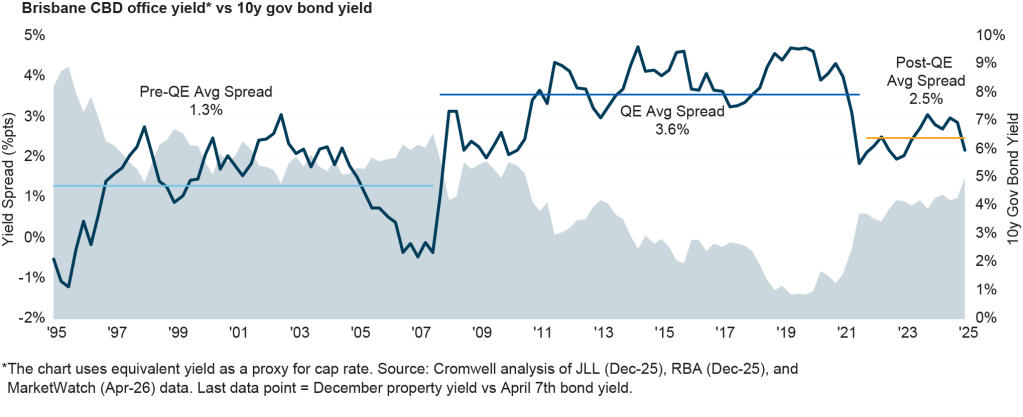
However, this relationship is not mechanical, and the risk premium embedded in cap rates is not fixed. It expands and contracts depending on market conditions, rent growth expectations, investor sentiment, and capital flows, and may move sharply or gradually, immediately or with a lag. The chart below highlights this variability in the spread between bond yields and property cap rates over time, using Prime Brisbane CBD Office as an example.


Importantly, it shows that the current spread is consistent with the long-term historical range, despite the recent increase in bond yields. The decade leading into the pandemic exhibited a wider yield spread, however this period was defined by below-trend economic growth and unprecedented monetary intervention.

Quantitative easing suppressed government bond yields3 to anomalously low levels, and pricing relationships observed during this period are unlikely to represent a sustainable long-term baseline. The chart also shows that periods of negative spread can occur when robust rent growth is expected.

Array
(
    [slides] => Array
        (
            [0] => Array
                (
                    [media_type] => image
                    [image] => Array
                        (
                            [image] => Array
                                (
                                    [ID] => 41364
                                    [id] => 41364
                                    [title] => interest_caprates_article_insight53_crk
                                    [filename] => interest_caprates_article_insight53_crk.jpg
                                    [filesize] => 674363
                                    [url] => https://www.cromwell.com.au/wp-content/uploads/sites/2/2026/04/interest_caprates_article_insight53_crk.jpg
                                    [link] => https://www.cromwell.com.au/higher-interest-rates-and-the-implications-for-unlisted-property/interest_caprates_article_insight53_crk/
                                    [alt] => 
                                    [author] => 8
                                    [description] => 
                                     => 
                                    [name] => interest_caprates_article_insight53_crk
                                    [status] => inherit
                                    [uploaded_to] => 41351
                                    [date] => 2026-04-21 06:53:58
                                    [modified] => 2026-04-21 06:53:58
                                    [menu_order] => 0
                                    [mime_type] => image/jpeg
                                    [type] => image
                                    [subtype] => jpeg
                                    [icon] => https://www.cromwell.com.au/wp-includes/images/media/default.png
                                    [width] => 1024
                                    [height] => 576
                                    [sizes] => Array
                                        (
                                        )

                                )

                            [alternate_images] => 
                            [mobile_image] => 
                            [tablet_image] => 
                        )

                     => Array
                        (
                            [video_type] => file
                            [autoplay] => 
                            [video_file] => 
                            [video_embed] => 
                            [image_placeholder] => Array
                                (
                                    [image] => Array
                                        (
                                            [image] => 
                                            [alternate_images] => 
                                            [mobile_image] => 
                                            [tablet_image] => 
                                        )

                                )

                        )

                    [title_block] => Array
                        (
                            [title] => 
                            [emphasise_title] => 
                            [emphasised_text] => real foundations.
                            [emphasis_style] => script
                            [content] => 
                        )

                    [text_width] => 
                    [button_group] => Array
                        (
                            [buttons] => 
                        )

                    [button_alignment] => 
                    [button_direction] => 
                )

        )

    [banner_placement] => inner
    [media_position] => full
    [full_height] => banner-short-height
    [banner_logo] => 
    [content_alignment] => 
    [block_theme] => Array
        (
            [block_theme] => Array
                (
                    [] => 
                    [background_colour] => 
                    [block_padding] => 
                    [add_anchor_id] => 
                    [anchor_id] => 
                )

        )

)

Cost of debt: asset and vehicle-level impacts

While required returns determine what assets should be worth, the cost of debt plays an important role in both the ongoing performance of leveraged assets and the prices buyers are able to pay.

For existing investments, higher interest rates – to the extent they are unhedged – increase borrowing costs, reducing net income and, in some cases, distributable earnings. The degree of impact varies materially depending on capital structure, hedging, and refinancing profiles, with assets exposed to near-term repricing more directly affected.

For new transactions, higher borrowing costs reduce the level of leverage that can be supported by a given income stream. Additionally, as the spread between asset yield and the cost of debt compresses, the benefit of leverage diminishes and equity returns decline.
In practical terms, higher funding costs reduce many buyers’ maximum bids, unless they are willing to accept lower returns. This effect is often reinforced by more conservative lending conditions. As interest rates rise, interest coverage ratios compress, and lenders may respond by reducing leverage, tightening covenants, and adopting a more selective approach to capital deployment. This further constrains the availability of capital, amplifying the impact of higher borrowing costs on both transaction activity and pricing.

However, the impact is not uniform. Investors with greater certainty over funding costs, or those less exposed to near-term repricing risk, may be better positioned to transact in this environment.

Liquidity: how markets actually reprice
Changes in required returns and borrowing costs are not reflected in property values immediately or uniformly. Instead, they emerge through transaction activity, which typically slows as financial conditions tighten.

As borrowing costs rise and lending conditions tighten, fewer buyers are able or willing to transact at prior pricing levels. This reduces competitive tension and leads to lower transaction volumes.

In this environment, transactions often occur between the most motivated sellers and well-capitalised or opportunistic buyers. Observed pricing can be influenced by the specific circumstances of those participants, rather than reflecting a broad cross-section of the market.

This helps explain why property markets often adjust in stages. Valuations are typically based on a body of transaction evidence, with individual transactions assessed for relevance and representativeness. In periods of low activity, isolated trades – particularly those involving motivated or forced sellers – may not be viewed as reflective of broader market conditions. As a result, a sufficient weight of evidence is often required before pricing benchmarks are reset. Importantly, this is not a sign of market dysfunction, but a feature of how private markets absorb new information.

Income stability vs valuation volatility: a temporary divergence


One of the defining characteristics of real estate is the relative stability of its income profile. Lease structures provide contractual cash flow, and rental adjustments typically occur gradually. Valuations, by contrast, can adjust more quickly through changes in required returns. This can create a divergence, where asset values decline due to higher cap rates even as underlying income remains stable or continues to grow. For long-term investors, this distinction is critical – valuation adjustments can create opportunities to acquire quality assets with robust fundamentals at more attractive pricing. It also reinforces the need to look beyond headline yields and focus on risk-adjusted returns across the entire investment hold period.

From adjustment to opportunity

Periods of rising interest rates are often accompanied by uncertainty and volatility. However, they can also present compelling opportunities for investors.

As highlighted in our previous article, the balance of supply and demand is the biggest driver of unlisted property performance over the long-term. The supply outlook for most property sectors was already significantly constrained heading into 2026, and recent inflationary pressures and interest rate changes linked to the Middle East conflict are likely to further limit new project commencements. For well-located existing assets with resilient tenant demand, this dynamic supports the medium-term outlook.

Risk-off sentiment and attractive entry pricing also create a more constructive environment for capital deployment. For investors with a long-term perspective and a disciplined approach to asset selection, dislocations between fundamentals and sentiment may enable the acquisition of quality assets below fair value.

As markets recalibrate, the focus shifts from navigating volatility to selectively capturing value. In that transition, the foundational drivers of unlisted property performance – income, asset quality, and long-term space market fundamentals – remain central to long-term investment outcomes.

1. ASX, as at market close 2nd April 2026
2. MarketWatch, as at market close from 27th February 2026 to 7th April 2026
3. Why Are Long-term Bond Yields So Low?, RBA (May-19)

This document has been prepared by Cromwell Funds Management Limited ABN 63 114 782 777, AFSL 333214 (CFM) and Cromwell Property Securities Limited ABN 11 079 147 809, AFSL 238052 (CPSL), both of which are wholly owned subsidiaries of Cromwell Corporation Limited ABN 44 001 056 980; and Cromwell Real Estate Partners Limited ACN 152 674 792 (CREP) as trustee for the Cromwell Creek Street Investment Trust. All statistics, data and financial information are prepared as at 31 December 2025 unless otherwise indicated. All dollar figures shown are in Australian dollars unless otherwise indicated. While every effort is made to provide accurate and complete information, Cromwell does not warrant or represent that the information is free of errors or omissions or is suitable for your intended use and personal circumstances. Subject to any terms implied by law that cannot be excluded, Cromwell accepts no responsibility for any loss, damage, cost or expense (whether direct or indirect) incurred by you as a result of any error, omission or misrepresentation in the document. This document is not intended to provide investment or financial advice or to act as any sort of offer or disclosure document. It has been prepared without taking into account any investor’s objectives, financial situation or needs. Any potential investor should make their own independent enquiries, and talk to their professional advisers, before making investment decisions. Past performance is not a reliable indicator of future performance. In particular, distributions and capital growth are not guaranteed. Various unlisted funds are referred to in this document. At the date of this document, the funds are not offered outside of Australia and, in some cases, New Zealand. Neither CFM nor CPSL receive any fees for the general advice given in this document. Cromwell Property Group (Cromwell) comprises Cromwell Corporation Limited ABN 44 001 056 980 (CCL or the Company) and the Cromwell Diversified Property Trust ARSN 102 982 598 (DPT or the Trust), the responsible entity of which is CPSL.

Person typing on a laptop

Learn

Home Research
November 27, 2025

Tracking the office recovery – five charts that tell the story

Colin Mackay, Research & Investment Strategy Manager, Cromwell Property Group


After a 19-year premiership drought, the Broncos have returned to the top of the rugby league totem pole. Another redemption story, not as long in the making, is underway in commercial real estate. Office was out of favour through the pandemic, weighed down by rising interest rates, subdued liquidity, and concerns that remote work would irreparably damage demand for space. Now, conditions are improving and sentiment is becoming more positive – and the proof is in the total return pudding. Below are five charts that highlight the recovery occurring in the office sector.

1. Asset prices appear to have bottomed

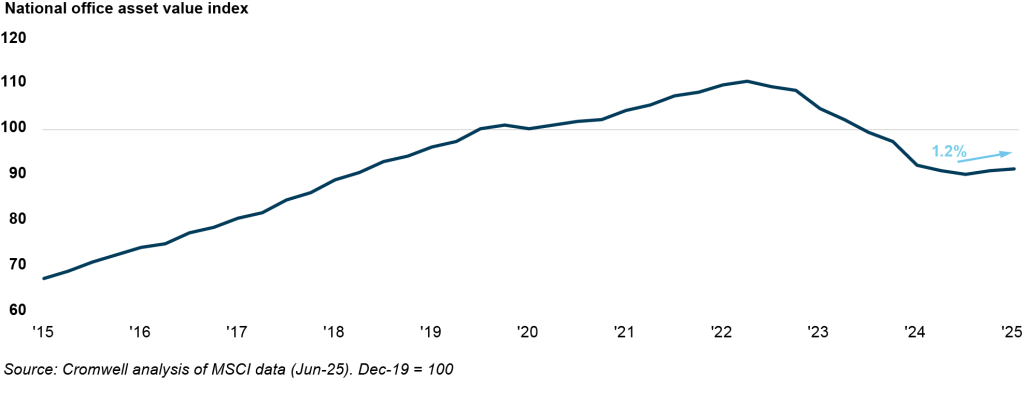
Office asset values across Australia fell -18% from late 2022 to the end of 2024. The devaluation cycle appears to have concluded, with appreciation of +1.2% recorded over the first half of 20251 . The downturn has created a compelling entry point for investors – office is currently providing a larger yield premium over the Australian 10-year Government Bond compared to the 30-year average.

The downturn has created a compelling entry point for investors – office is currently providing a larger yield premium over the Australian 10-year Government Bond compared to the 30-year average.

2. Investment performance is improving

Stable yields and ongoing income growth have contributed to an improvement in total return. Performance has been positive for the last two quarters, leading to the strongest rolling annual total return since early 2023.

3. Tenant demand now exceeds pre-pandemic levels

The income growth side of the ledger has been driven by strengthening tenant demand. Remote work did have a significant impact on occupied space in 2020, however demand has been increasing for nearly five years now. The recovery is even more impressive when split by asset quality – prime grade assets have recorded demand growth of +11% over the last five years, while demand for space in secondary assets contracted by -9%.

4. Rents are growing in most markets

Stronger tenant demand has flowed through to rents. Over the last five years, rents have increased in every major CBD market except Melbourne. Consequently, annual national CBD rent growth has been outpacing inflation since September 2024. Additionally, prime incentives are significantly higher than the long-term average in every major market, suggesting there is scope for them to fall if leasing conditions remain favourable. Decreasing incentives would provide a tailwind for income growth.

5. Future supply risk is lower than average

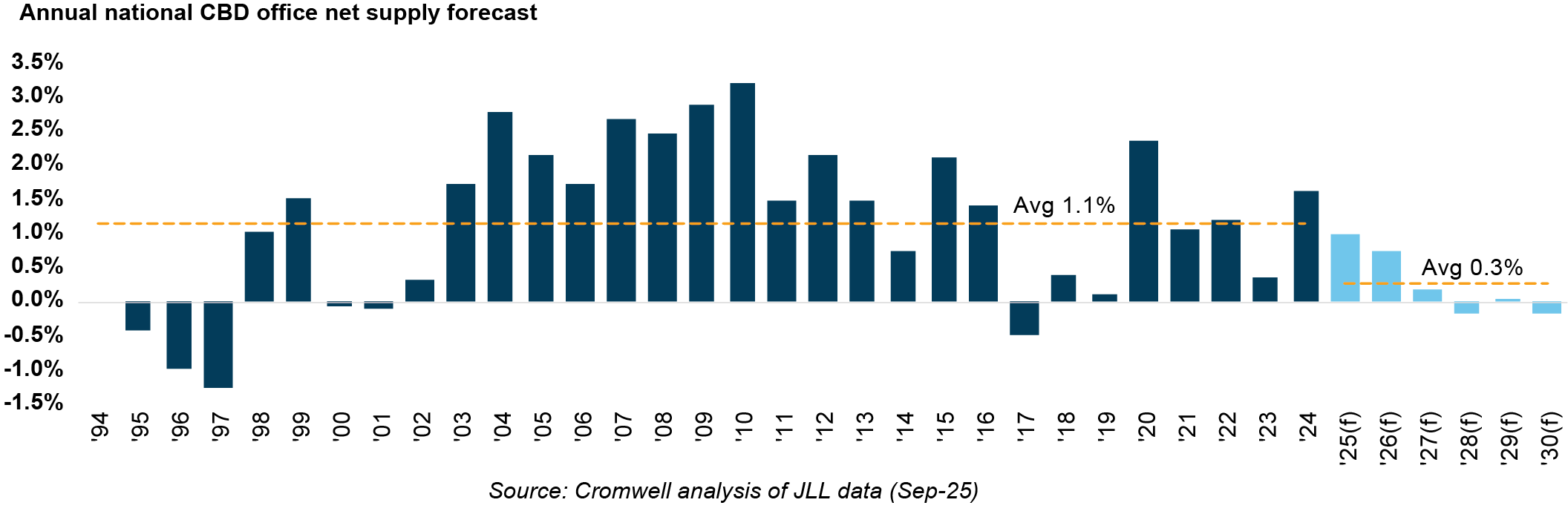
Construction is prohibitively expensive and new developments are very rarely “stacking up” in the current environment. With few projects breaking ground, the supply of CBD office space is expected to increase by only +0.3% p.a. to 2030, well below the long-term average annual rate of +1.1% and significantly lagging white collar jobs growth. A constrained supply pipeline should put downwards pressure on vacancy rates, supporting the sustainability of the recovery and the outlook for rent growth.

Heading in the right direction

While the turnaround of a real estate sector doesn’t happen overnight, multiple metrics show office is improving. For some, fear of catching a falling knife is turning into fear of missing out on the recovery upswing. With dual levers of stronger demand and weaker supply boding well for a tightening of vacancy and continued rent growth, office has every chance of topping the investment return table over the coming year.


  1. Cromwell analysis of MSCI data (Jun-25)
Person typing on a laptop

Research and Insights

Home Research
March 8, 2024

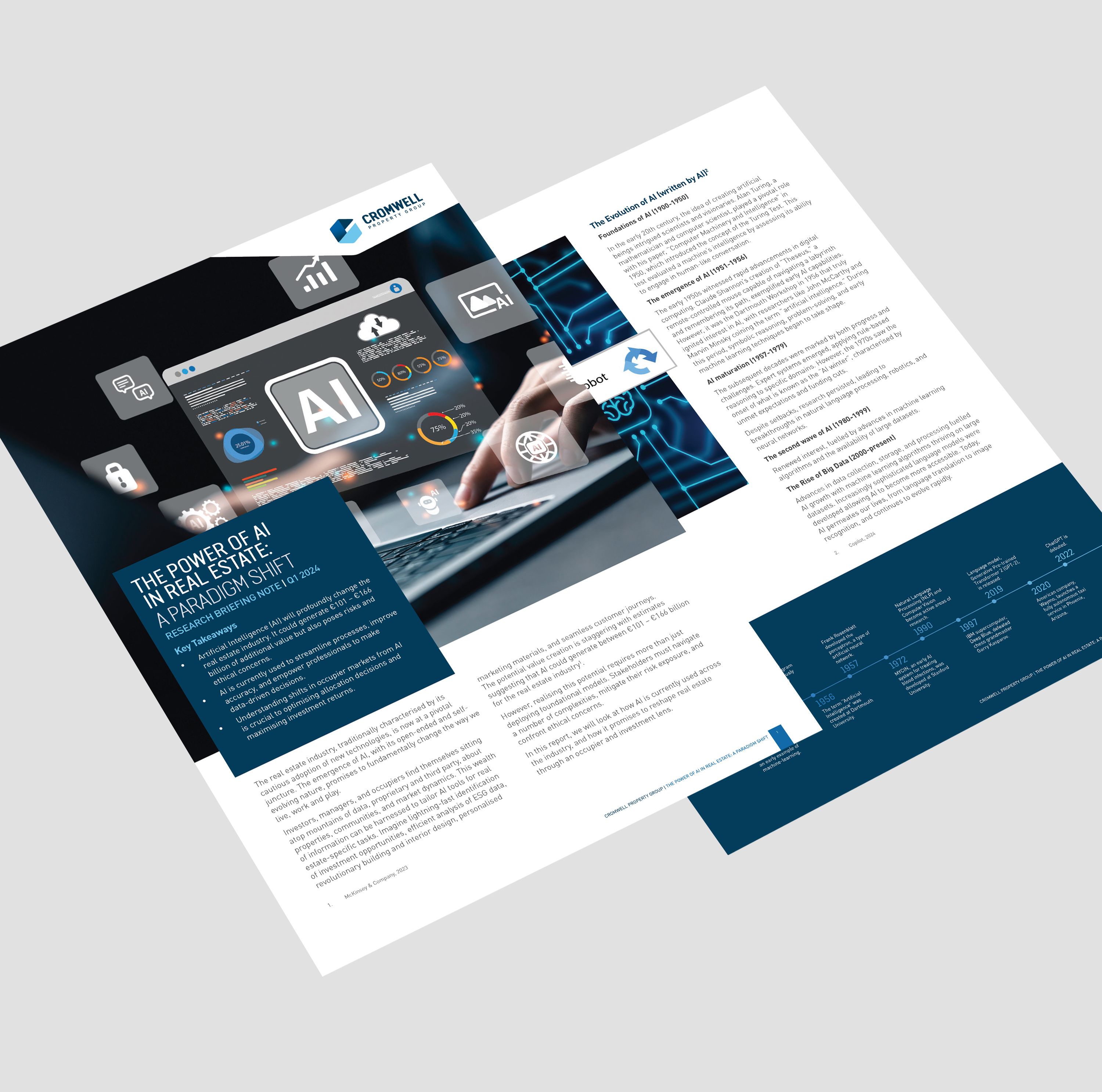
The power of AI in real estate: a paradigm shift

AI has the potential to profoundly change the real estate industry in coming years, and is projected to add up to $275 billion to market values. Indeed, understanding shifts in occupier markets from AI is crucial to optimising allocation decisions and maximising investment returns. This month, Cromwell’s Research and Investment Strategy Manager, Colin Mackay, takes a close look at the utilisation of AI, including how to best understand the risks and ethical concerns around the topic.

View the full report here.

Person typing on a laptop

Research and Insights

Home Research
January 4, 2024

Biodiversity: a fundamental part of our natural capital

Consideration of the environmental impact of real estate is usually focussed on greenhouse gas emissions during construction and operations. However, another critical aspect is the impact of the built environment on biodiversity. In this briefing note we explore the connection between biodiversity and real estate. We explain why investors that align their strategies to accommodate new regulations will also enhance their asset financially, socially, and environmentally.

View the full report here.


Person typing on a laptop

Learn

Home Research
October 11, 2023

Redefining the office flight to quality: A Sydney CBD case study

Colin Mackay, Research & Investment Strategy Manager, Cromwell Property Group


“Flight to quality” has been the real estate industry’s phrase of the year, particularly as it pertains to the office sector. While Cromwell agrees that a flight to quality is occurring and will continue to play out over the medium-term, our opinion of what that flight actually is – and indeed our definition of quality – is somewhat contrarian.

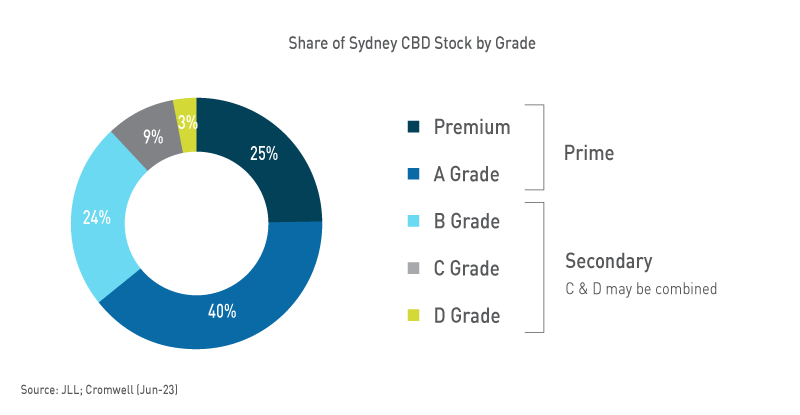
Quality has become synonymous with Premium – the top grade of office buildings. These buildings are modern developments with the largest floorplates, most internal amenity, and luxurious finishes and fitouts – and which naturally charge the highest rents. While this type of asset is an important part of the market, it’s worth assessing whether the popular narrative fits all the facts.

Are occupiers flocking to Premium assets at the expense of Secondary stock? Does the top-end of town hold all the cards?

Net absorption is important but doesn’t tell the whole story


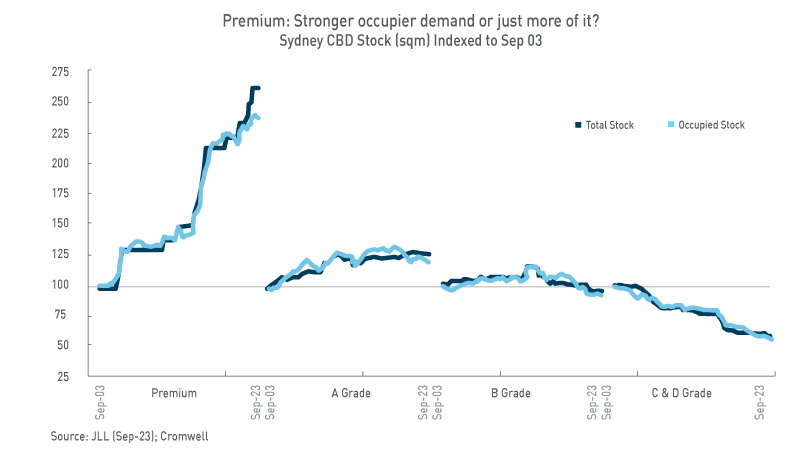
Net absorption is the metric often cited as evidence of the flight to (Premium) quality. In the Sydney CBD, Premium stock has recorded the strongest net absorption over the last 20 years at around +624,000 square metres (sqm), an increase in occupied stock of +137%. A Grade’s net absorption (+270k sqm) has been the second strongest over that time period, with the amount of occupied space increasing +18%. On face value, it’s easy to see why the “Premium is best” narrative has emerged – but there’s more to the story!

Premium has also seen the largest increase in total space.


Net absorption is the change in occupied (leased) space over a given period (often a quarter or year), represented in square metres. It is calculated by subtracting the amount of occupied space at the start of a period from the amount of occupied space at the end of a period. Positive net absorption means the amount of occupied space has increased, while negative net absorption represents a decrease.


Growth in occupied space is an expected by-product of the substantial increase in supply. On the other side of the coin, B Grade has recorded negative net absorption but also a decrease in total space – occupiers can’t lease space that doesn’t exist.

This dynamic is often seen in the lower grades as buildings are “withdrawn” (removed) from the market through conversion to different uses (e.g. residential). When we consider that rents are a function of demand and supply, it becomes clear that looking only at net absorption provides an incomplete picture of market conditions – we also need to look at the supply side of the equation.

On face value, it’s easy to see why the “Premium is best” narrative has emerged – but there’s more to the story!

Vacancy paints a different picture


Vacancy rates highlight a deterioration of demand relative to supply at the top end of the asset grade spectrum. In the Sydney CBD, Premium has the highest vacancy rate in absolute terms and when compared to its historical average.

B Grade has proven more resilient from an occupancy perspective, with vacancy actually decreasing over the last year.


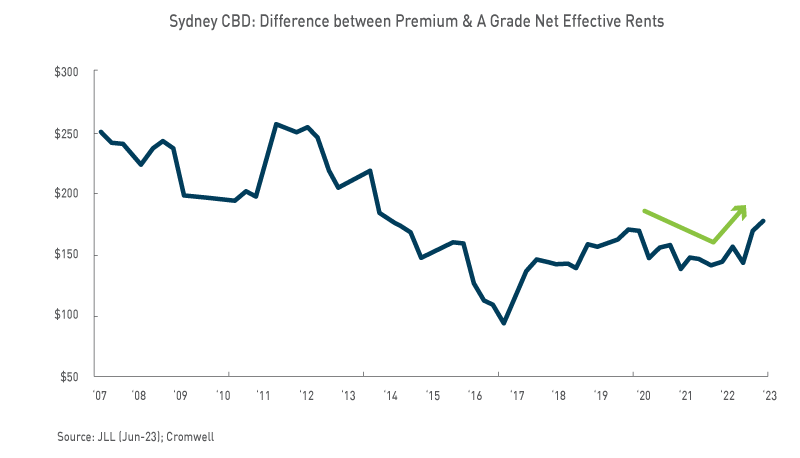
Despite elevated vacancy, Premium’s net effective rental growth has outpaced A Grade and B Grade over recent quarters. There are a couple of potential explanations for this counterintuitive result.

Time lags: It takes time for changing conditions to be grasped by market participants, for negotiations to be had and leases signed. Premium had the lowest vacancy rate until mid-2022, with its main occupiers adopting a “wait-and-see” approach to space decisions through the pandemic. Now, Premium occupiers are handing back space and driving vacancy higher, but current rental outcomes are reflecting the tight conditions of prior quarters.

Affordability: The spread between Premium and A Grade rents narrowed over 2021-22 as Premium incentives increased. Industry feedback suggests occupiers have taken advantage of the relative affordability to upgrade, taking up less space but at a higher rate per sqm. This is positive for market rental growth but less so for income growth, given the occupancy effect. We expect Premium upgrading to run out of steam as affordability worsens, with the spread recently increasing to its widest level since 2014.


Incentives are financial ‘sweeteners’ offered by landlords to encourage tenants to lease space. Common incentives include contributions to tenant fitout costs, rent-free periods, and rental abatements where the amount payable is reduced for a period of time. The rent received by a landlord after incentives are accounted for is referred to as an “effective” amount.


In any case, for investors, there’s limited value in knowing today’s performance – what really matters is the future.

Good things come in small packages


In our view, it will be difficult for Premium stock to maintain the current pace of rental growth, with A Grade stock likely to outperform over the medium-term due to lower vacancy, a less substantial supply pipeline, and favourable occupier trends.

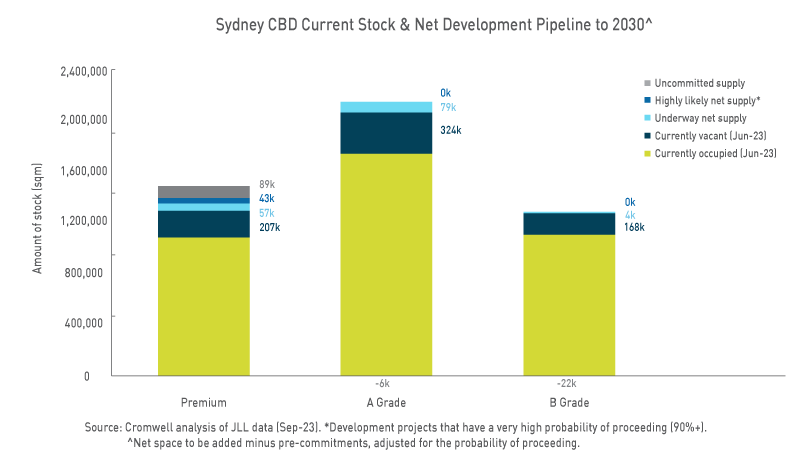
Cromwell estimates there are 265k sqm of Premium space in the Sydney CBD which will need to be leased in the near term based on space currently vacant or completing by the end of 2024. This “baked in” amount is equivalent to 19.7% of current Premium stock. Future developments may deliver new supply to the market post-2024, however we only consider 43k sqm as highly likely on a probability-adjusted basis.

A Grade has a larger amount of space requiring leasing (403k sqm); however, it is smaller as a proportion of existing stock (18.8%). Unlike excess B Grade stock which may be withdrawn from the market via change of use, the only feasible option for Premium space is absorption via leasing. On this front, the Premium end of the market faces some challenges.

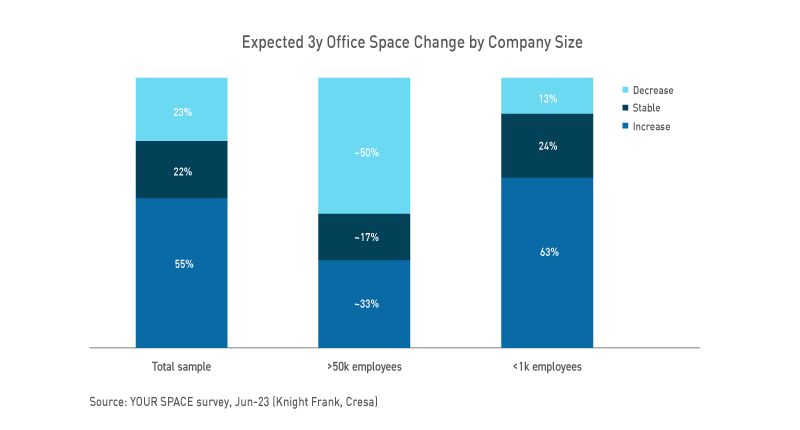
Space contraction impacts from work-from-home are being felt most keenly by assets with large floorplates. These buildings are expensive to divide into smaller tenancies and typically cater to the largest occupiers. Research1 points to an inverse relationship between occupier size and office usage, which is then being reflected in organisations’ plans to expand or contract their office footprint. The industries that predominantly occupy Premium buildings (financial services, professional services, tech) also demonstrate a lower propensity to use the office post-COVID.

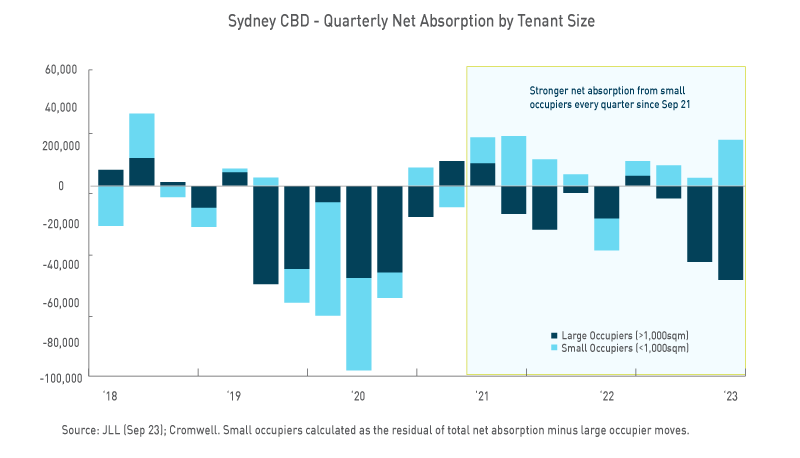
Australian leasing data corroborates the research findings. Net absorption has been far stronger across smaller (<1,000sqm) occupiers than large occupiers. The tendency to expand has also been far more positive, with smaller occupiers on average expanding their footprint by ~20% (national leasing deals from 1Q21 to 2Q22) compared to an average contraction of ~13% for occupiers larger than 3,000sqm2.

We believe the in-office bias of smaller occupiers versus larger occupiers reflects the nature of work typical across these organisations. Bigger firms are more regimented and siloed, with large administrative “back office” functions that predominantly perform focused tasks individually. These firms may have also invested more heavily in digital collaboration tools which facilitate remote work across a more geographically dispersed workforce. Smaller firms are more dynamic, with employees wearing multiple hats and undertaking work that tends to favour face-to-face interactions. Regarding smaller firms’ space expansion, this may be linked to their much stronger headcount growth through the pandemic. Businesses with 5-199 employees saw employment growth across the main office-using industries of 4.6% p.a. from Jun-19 to Jun-22, compared to -0.2% p.a. for businesses with 200+ employees3.


One of the arguments often made against exposure to smaller occupiers is that they are riskier than large occupiers, but the data shows this isn’t the case. While very small firms do fall over more often, those with 20-199 employees have nearly identical survival rates to firms with 200+ employees. The smaller occupier bracket is also broader and more diversified, with office-using businesses spanning many industries. By comparison, the large firm bracket is dominated by financial and professional services. Overexposure to large occupiers can also increase the risk that a significant portion of an asset becomes vacant at a single point in time, rather than being spread over a manageable leasing horizon.

Price doesn’t always equal quality


Conflating luxury with quality ignores the needs of many office occupiers. While the largest companies attract the most attention, most office-using Australian businesses are small and medium-sized enterprises (SMEs)4. With cost being the top driver of real estate decisions5, these SMEs are in the market for a Toyota, not a Rolls-Royce with all the extras. They want the highest quality office, in the best location, but within their price bracket. So then, what is “high quality” office? Ultimately, it’s space which meets the needs and preferences of its target occupiers.

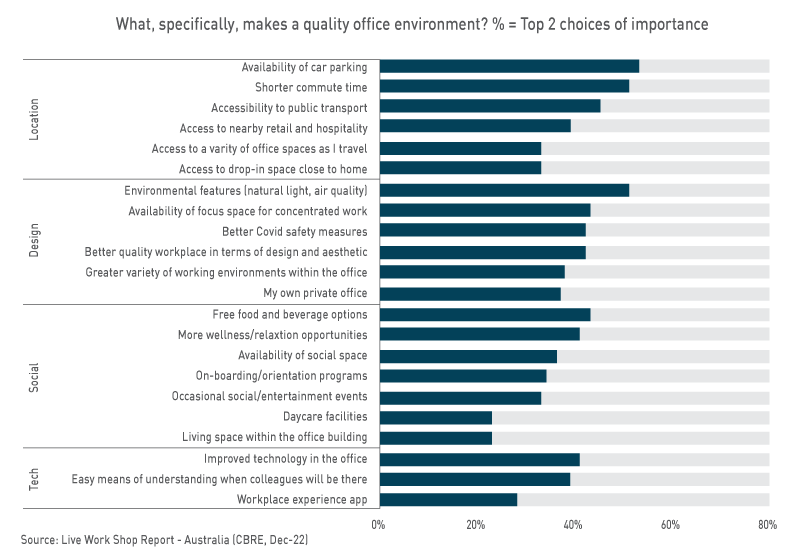
Some occupier preferences are timeless and will persist no matter how workstyles and space usage evolve, for example availability of natural light, convenient access to transport and plenty of nearby amenity (e.g. dining and gyms). These are hygiene factors valued by occupiers of any industry or size.

The pandemic has rendered some requirements less important. Floorplate size has historically been a measure of quality and is one of the criteria that determines whether a building is considered Premium or a lower grade. But with occupiers’ office usage shifting towards collaboration and social connectivity, a smaller floorplate can create more incidental interactions and a better ‘buzz’ in the office. While there is a minimum viable size in terms of efficiency and layout, we’re finding bigger isn’t always better in the eyes of occupiers.

Other requirements have increased in importance as occupiers shift to a new way of working. A greater level of embedded technology is expected, to ensure a flexible working model can be facilitated. Greater diversity of spaces is needed to support focused work, collaboration, and flexibility, with implications for building layouts and landlord-led fitouts.

Sustainability also continues to increase in importance, with a wider array of organisations focusing on both the financial and social benefits it can provide, including staff attraction and retention.

Greater diversity of spaces is needed to support focused work, collaboration, and flexibility, with implications for building layouts and landlord-led fitouts.

Not always the more sustainable choice


The preference for sustainable space is becoming more tangible and spans a variety of stakeholders, including end users, occupiers, and investors. Premium buildings often have the highest sustainability ratings (e.g. NABERS), something which is used to support the view that occupiers will increasingly gravitate to these assets over time. But again, these ratings don’t tell the whole story.

While new Premium assets are top performers from an operational emissions perspective (e.g. energy usage), production of building materials and construction activities are the largest producers of embodied carbon emissions6. As the grid decarbonises, embodied carbon’s share of built environment emissions is expected to increase from 16% in 2019 to 85% by 20506 – in the pursuit of net zero, minimising the demolition of existing buildings and the construction of new ones will become far more important than building-specific energy efficiency. As the importance of embodied carbon becomes more well known and stakeholders adopt a whole-of-life view of emissions, newly built Premium assets may not be considered the greener option.


Embodied carbon: the emissions generated during the manufacture, construction, maintenance and demolition of buildings – Green Building Council of Australia (GBCA)


Is this only a Sydney theme?

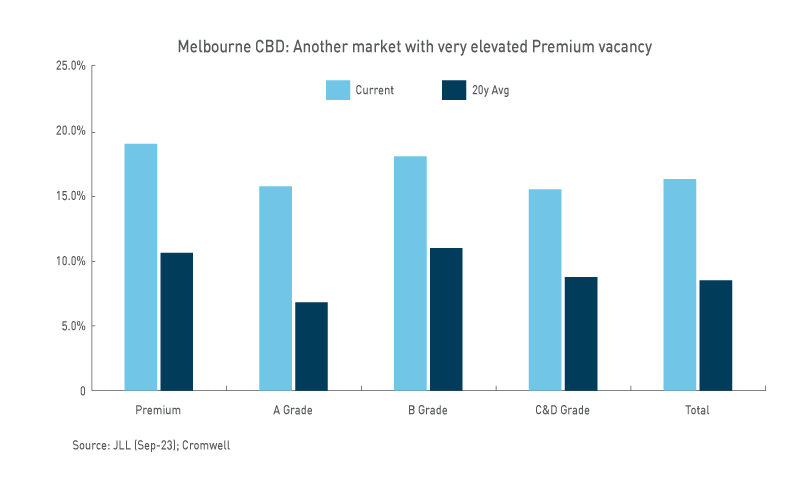
While this paper has focused on the Sydney CBD for simplicity and brevity, we see the same dynamics playing out in Melbourne. The CBD Premium vacancy rate is almost 19%, and Cromwell forecasts the amount of Premium stock will increase by 15% by 2026 based on new supply currently under construction. The same occupier trends are also occurring, with small occupiers recording positive net absorption of over +23k sqm since Dec-19, compared to negative net absorption of almost -241k sqm for large occupiers.

We believe the flight to quality is occurring across all grades – not just Premium – as occupiers seek space that is well-located, offers high amenity, and enables a flexible approach to working, but within their price bracket.

Look beyond the headline


“Flight to quality” has been a popular theme in the office sector. While positive net absorption has been used to support the notion that Premium buildings are outperforming lower grade assets, the metric can’t be looked at in isolation. Investors gain a more comprehensive understanding of market conditions by also considering other factors such as vacancy, supply impacts and occupier demand trends. We believe the flight to quality is occurring across all grades – not just Premium – as occupiers seek space that is well-located, offers high amenity, and enables a flexible approach to working, but within their price bracket. In our view, the A Grade segment of the market is best-positioned as it occupies an affordability-quality sweet spot, supported by ongoing demand from smaller occupiers and a smaller supply pipeline.


  1. Empty spaces and hybrid places (McKinsey, Jul-23); U.S. Office Occupier Sentiment Survey (CBRE, May-23)
  2. Australian Office Footprint Analysis (CBRE, Oct-22)
  3. ABS (May-23); Cromwell. Main office-using industries includes: Information media and telecommunications; Rental, hiring and real estate services; Professional, scientific and technical services; Administrative and support services; Education and training (private). Financial services employment breakdown is not published by the ABS.
  4. SMEs defined as businesses with 5-199 employees, within the same office-using industries as previously defined.
  5. What Occupiers Want (Cushman & Wakefield, Jul-23)
  6. Embodied Carbon & Embodied Energy in Australia’s Buildings (GBCA; thinkstep-anz, Aug-21)
Person typing on a laptop

Learn

Home Research
September 14, 2023

Industrial: Still delivering the goods

Colin Mackay, Research & Investment Strategy Manager, Cromwell Property Group


Industrial has been Australian real estate’s star performer for a decade, notching up an annualised 10-year return of 14.2%1. While the rate of new supply has increased, the availability of space has been unable to match pace with surging demand. Australia has become the lowest vacancy industrial market in the world2, contributing to record rental growth of almost 25% in the year to March 20233. The sector’s strong momentum continues, and the outlook is bright, as several long-term tailwinds drive demand.


E-commerce

The shift in retail activity from physical stores to digital channels drives demand for industrial space in several ways:

  • warehouse space is needed to store inventory which would have otherwise sat in a store;
  • e-commerce tends to offer a wider range of products, rather than the curated selection that a specific retail store might be limited to, necessitating more storage space; and
  • goods purchased online have higher rates of return, and space is needed to handle the reverse logistics.

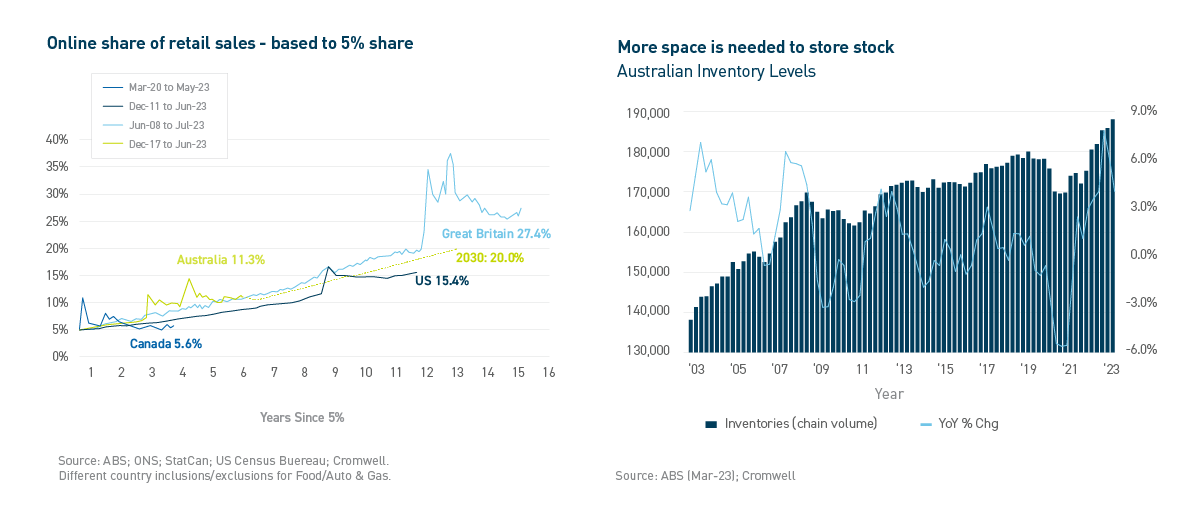
Increased storage and space needs mean pure-play e-commerce requires three times the distribution space of traditional retail4. Customer preferences are primarily driving the shift to online, particularly as demographic change sees ‘digital natives’ become the dominant consumer segment. As scale and investment lead to greater efficiencies and profitability, the shift may gain another momentum boost.

E-commerce in Australia is following a similar trajectory to Great Britain – it is on track to hit a market share of 20% of all retail sales by 2030 despite growth slowing from pandemic peaks. With 70,000sqm of logistics space needed for every incremental $1 billion of online sales5, e-commerce alone could generate industrial space demand of almost 600,000sqm p.a. over the next seven years6.

Supply chain resilience

As explained in last year’s Supply Chain Adaptation paper, one of the most immediate and lasting impacts of the pandemic has been supply chain disruption, with erratic swings in demand exacerbated by congested ports and border restrictions. The pendulum is now swinging from the prevailing ‘Just-In-Time’ supply chain philosophy, where goods are shipped on demand and arrive just before they are needed, back towards a ‘Just-In-Case’ approach. Under this approach, higher volumes of inventory and production are stored and undertaken locally, where it can be better guaranteed.

Supply chain experts estimate the majority of Australian occupiers are currently holding approximately 30% more inventory compared to pre-pandemic levels7. While this degree of buffer will likely decrease as supply chain disruptions ease, a full return to previous inventory levels is unlikely, meaning more warehouse space will be needed on an ongoing basis for storage.

Online-share-article


Infrastructure

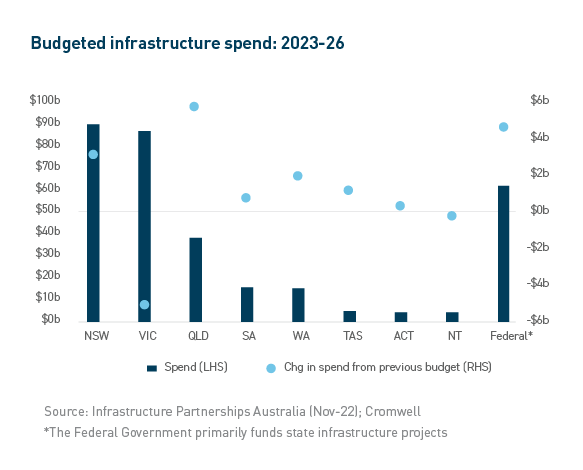
Infrastructure development is a key priority in Australia as we contend with ongoing urbanisation and densification, along with surging population growth. Across the 2022-23 Budgets, $255 billion in government expenditure was allocated to infrastructure for the four years to 2025-26, an increase of $7 billion or 2.7% compared to 2021-229. In dollar terms, NSW has the highest allocation to infrastructure ($88 billion), while QLD saw the largest increase on the previous year ($5.7 billion). The three East Coast states of NSW, Victoria, and QLD account for 83% of the committed infrastructure funding.

Budget-infrastructure

Infrastructure investment stimulates demand for industrial real estate in a couple of ways. As new infrastructure is built, congestion and connectivity improve, lowering transport and operating costs and allowing more efficient movement of people and goods. This helps businesses to grow and increases the supportable population base. More activity and more people, mean more demand for industrial space to power the ‘engine room’ of a bigger economy. The more direct source of infrastructure-related industrial demand occurs during a project’s construction phase, as space is needed to manufacture, assemble, and store materials and components.

Customer proximity

The time it takes to reach the customer is of critical importance in modern supply chains. Customers increasingly expect products to arrive faster, more flexibly, at the time promised, and with lower delivery costs. While not a driver of aggregate space demand, the focus on customer proximity does contribute to stronger rental growth for well-located properties.

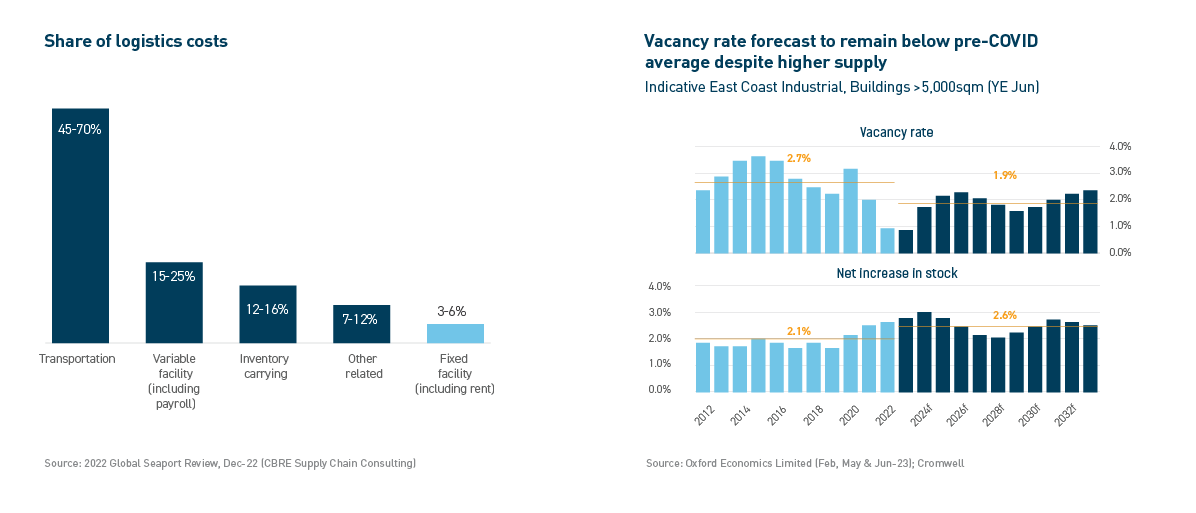
Transport accounts for 45-70% of logistics operator costs compared to 3-6% for rent10. This low proportion of cost means well-located industrial assets with good transport access and proximity to customers have long runways for rental growth, as occupiers prioritise lower (cheaper) transport times – an up to 8% increase in rent can be justified if a location reduces transport costs by just 1%.

Share-logistics


But what about supply risk?

While the demand drivers for industrial are clear, the supply-side response is just as important in determining asset performance. In previous cycles, downturns have arisen from excess speculative development creating too much stock and dampening rental growth. But there are several reasons why the sector is insulated from a supply bubble this time around. Firstly, labour and materials shortages are making it challenging to physically build new assets, even though development is commercially attractive. Secondly, there is a lack of appropriately zoned, serviced land available for development. While land is becoming available farther out from metropolitan centres (e.g. Western Sydney Aerotropolis), this land is not appropriate for many occupiers or uses which require closer proximity to customers. It will also take time for this land to become development-ready, due to planning, infrastructure (e.g. road widening), and utility servicing (e.g. water connection) delays. Finally, the sector has matured and become more ‘institutional’ over the current cycle, with a shift in ownership from private capital to large, sophisticated owners and managers. Institutional owners take a more cautious approach to development, contingent on higher levels of tenant pre-commitment, reducing the risk of a speculative supply bubble. These factors will make it difficult for supply to keep pace with – let alone surpass – demand.


Demand story remains intact

Industrial has been the “hot” sector in recent years, and it’s reasonable to question whether it’s been squeezed of all its juice. The pandemic provided a boost to many of industrial’s demand drivers (e.g. e-commerce) and introduced new ones (e.g. supply chain resilience). While these tailwinds have abated somewhat from their pandemic highs, they continue to contribute to a positive demand outlook. Arguably more importantly, the supply response remains constrained by shortages (e.g. labour/materials/land) and delays (e.g. planning), and it will take several years for the sector to return to a more normal supply-demand balance. As a result, Cromwell expects healthy rental growth to be a key driver of industrial returns, and for the sector to remain attractive despite expansionary pressure on cap rates.

Footnotes

1. The Property Council-MSCI Australian All Property Digest, June 2023 (MSCI)
2. Australia’s Industrial and Logistics Vacancy 2H22, December 2022 (CBRE Research)
3. Logistics & Industrial Market Overview – Q1 2023, May 2023 (JLL Research)
4. What Do Recent E-commerce Trends Mean for Industrial Real Estate?, Mar-22 (Cushman & Wakefield Research)
5. Australia’s E-Commerce Trend and Trajectory, September 2022 (CBRE Research)
6. Projection based on historical 15-year retail sales growth of 4.0% p.a. (Cromwell, Jun-23)
7. Is ‘Just-in-Time’ a relic of a time gone by in Australia?, March 2023 (JLL)
8. Global Reshoring & Footprint Strategy, February 2022 (BCI Global)
9. Australian Infrastructure Budget Monitor 2022-23, November 2022 (Infrastructure Partnerships Australia)
10. 2022 Global Seaport Review, December 2022 (CBRE Supply Chain Consulting)

About our managed commercial property funds

Our suite of funds offers access to unlisted property trusts, ASX-listed Real Estate Investment Trusts and internationally listed small cap securities, providing different methods of investing in commercial property and diversifying your portfolio.

Person typing on a laptop

Learn

Home Research
July 18, 2023

Ignore the noise: Australian office isn’t dead (or dying)

Colin Mackay


sydney-harbour

The future of offices in a post-pandemic world continues to be a topic of robust conversation.

Arguably, most airtime on the subject has been given to dramatic statements like “expect the death of the office” – perhaps recycling articles from the past decade that incorrectly asserted a retail apocalypse was nigh! The reality is that, as retail has adapted to the internet age – and survived – so too will office spaces adapt to these changing conditions.

It can be easy to fear the worst, especially as reports of landlords handing keys to the bank; assets sitting unoccupied; and valuations declining 80% take up the front page of newspapers.

It’s important, however, to understand that these events have been limited to the US, a challenged market with different financial, social, and real estate context. The outlook for office in Australia is markedly more positive for several reasons.


Higher office occupancy

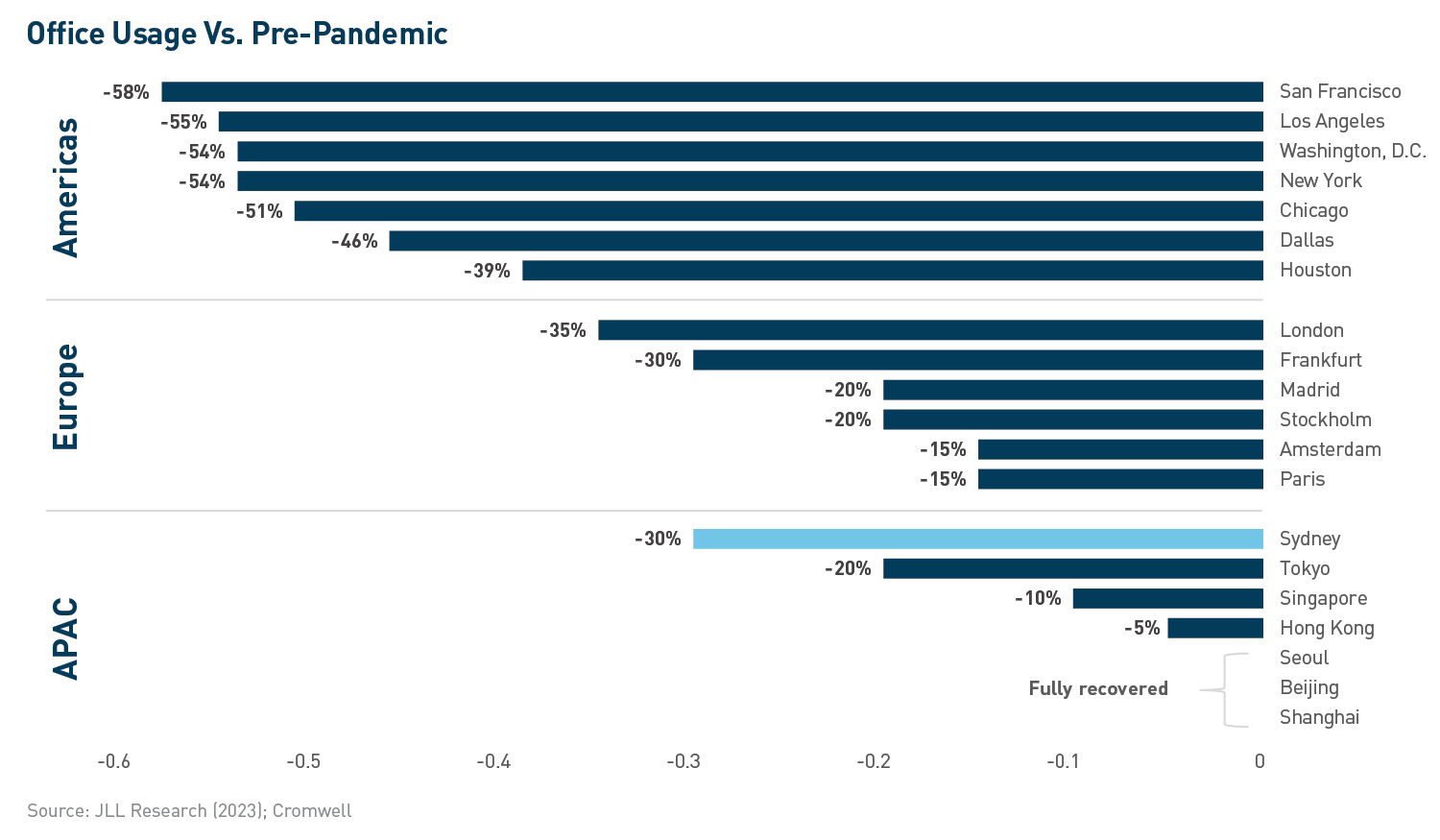
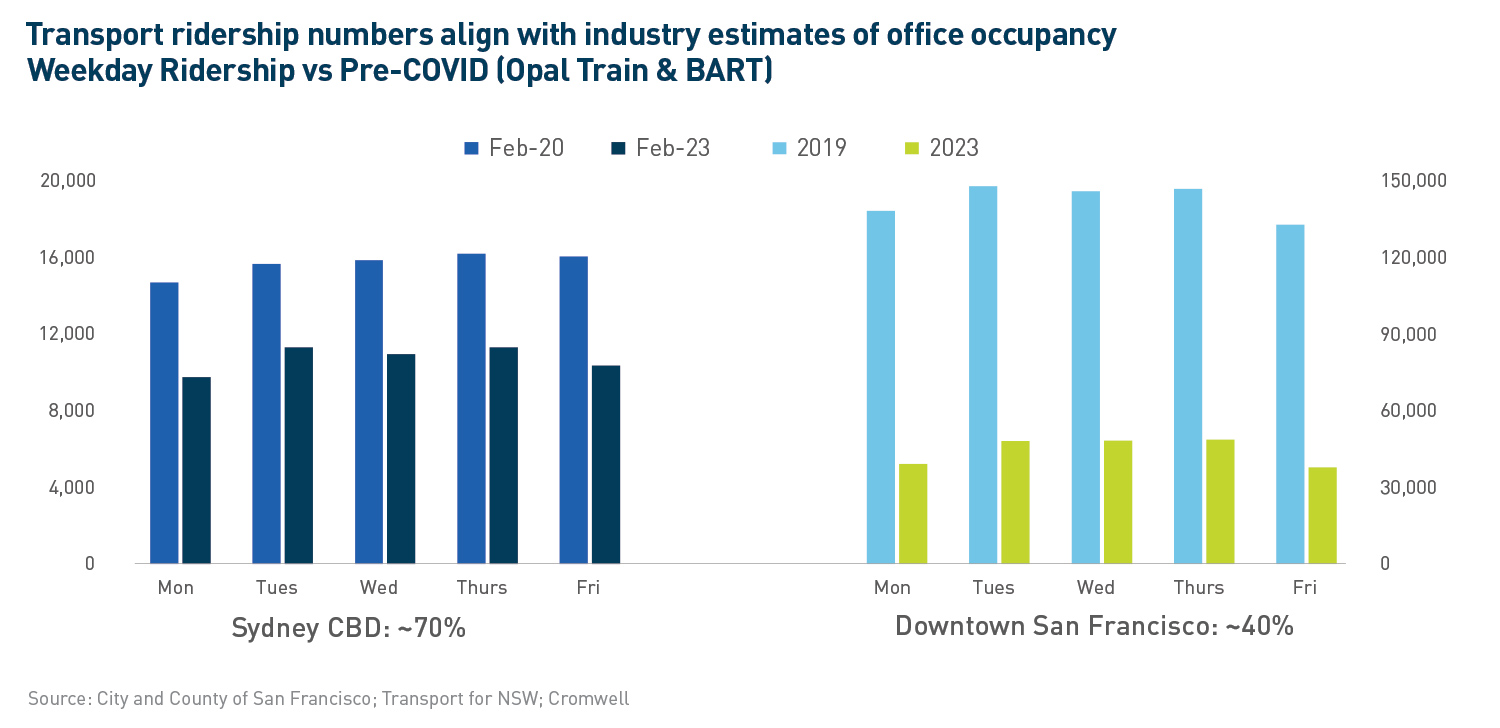
The return to the office has been strongest in Asia-Pacific, where office occupancy is sitting at 70-100% of pre-pandemic levels1. Workers in North America have been the most reluctant to come back to CBDs (45-65%), with Europe (65-85%) splitting the two regions. At the individual market level, the likes of Shanghai and Beijing are back at pre-pandemic occupancy; Sydney has recovered to 70%; London is a bit weaker at 65%; and the major US cities are significant laggards with office-based work still below half of pre-pandemic levels in Chicago (49%), New York (46%), and San Francisco (42%).

graph_officeusage

Propensity to return to the office appears to be driven by a number of factors, including cultural expectations (e.g., Tokyo/Seoul); industry composition (e.g., finance vs tech); and ease of commute (e.g., rapid transit vs LA traffic). While commute time is highlighted by workers around the globe as the most important driver of returning to the office2, another critical factor is the micro-location of each office building. In addition to influencing commute time, different locations can vary significantly in terms of crime and safety risks, amenity (e.g., restaurants), and environmental desirability (e.g., proximity to water/green spaces).

Australia measures up very attractively on these characteristics, offering reliable rapid transit, exceptional proximity to desirable environmental features, a high density of quality amenity integrated throughout the CBDs, and very low rates of crime. The return to the office will likely gather more steam in the coming months as large employers mandate a minimum number of days in the office per week, as announced recently by NAB and CommBank. However, over the long-term, locations and assets which can attract employees through choice rather than coercion will outperform.

/graph_ridershipnumbers

graph_workpointdensity


Expanding space requirements

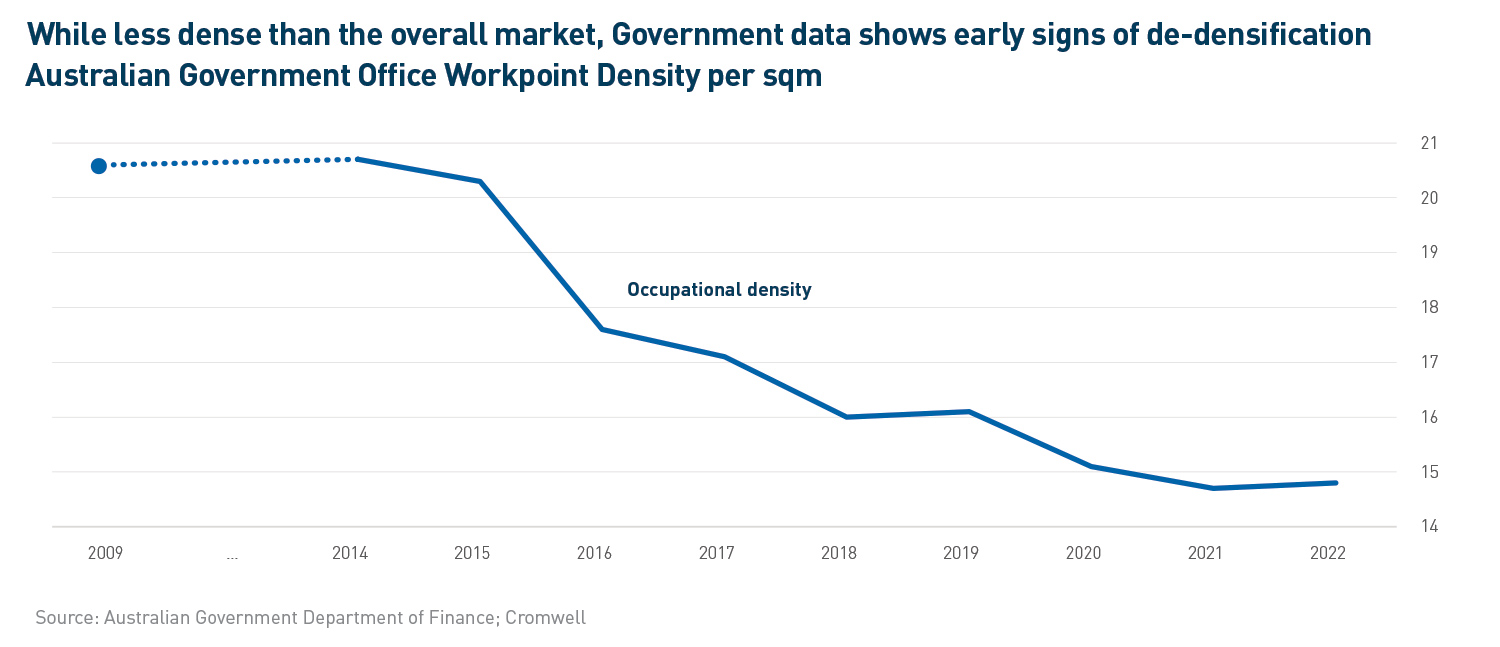
One of the forces expected to offset the impact of remote work is the expansion of workspace ratios – the amount of office space per employee. Forty years ago, in the days of private offices, Australian offices had more than 20 square metres (sqm) of space per employee. Over time, as occupiers sought more “bang for their buck”, desks became more tightly packed together and the corner office was sent to the scrap heap.

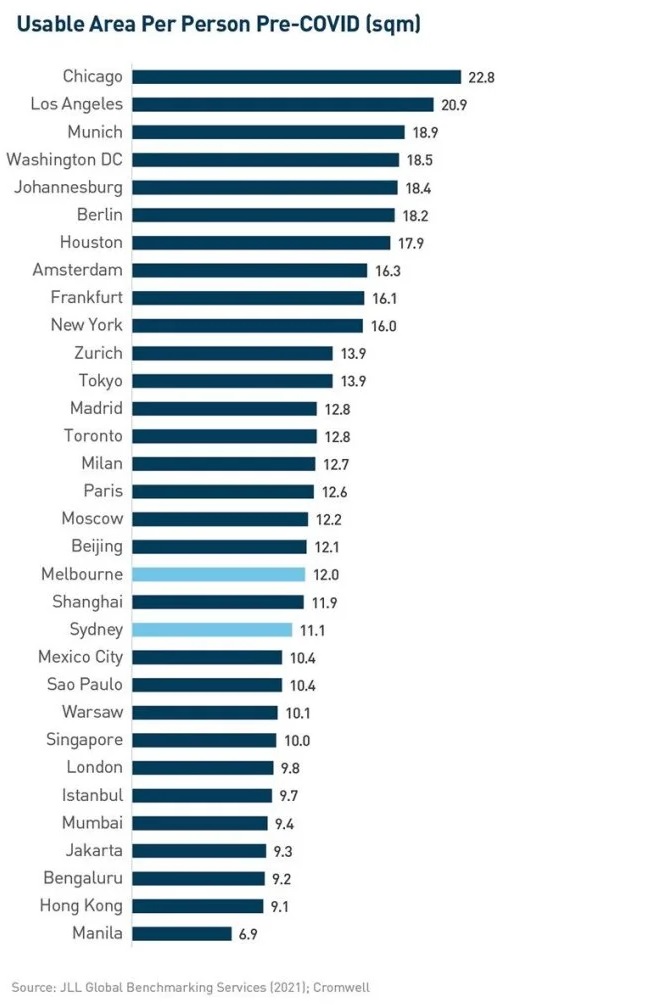
The result has been densification of the workplace, with the pre-COVID workspace ratio sitting at 11.1 sqm per employee for Sydney and 12.0 sqm for Melbourne3.


The experience of the pandemic has initiated a shift in the purpose of the workplace and workstyles. The office is increasingly becoming a place for collaboration and social connection rather than focus work, meaning a greater need for meeting, gathering, and collaboration spaces. There is also a need to lower density and make workplaces more comfortable from an employee wellbeing and retention perspective, as employers fight for top talent. Studies have shown that inadequate privacy and space is the dominant cause of workspace dissatisfaction4.

The office is increasingly becoming a place for collaboration and social connection.


In the US, markets such as Chicago and Los Angeles have ratios above 20 sqm per employee, with even New York at 16.0 sqm3. The pandemic-initiated evolution of the work environment can be achieved in these markets by simply recalibrating (and even shrinking) existing footprints.


Contrast this environment with Australia, where workspace ratios are below the global average of 13.3 sqm3 and potential space efficiencies are limited. In this market, the recalibration will likely require additional space, providing a source of demand and limiting the amount of rent-dampening excess stock.


graph_bankloanexposure

Appropriate financing

Earlier in the year, some high-profile office defaults in the US by Brookfield, and a PIMCO-owned landlord, kicked off concerns about a real estate debt crisis. Risks are certainly elevated in the US, given the aforementioned demand challenges, which will pressure serviceability and put significant downwards pressure on valuations. While pockets of distress may emerge in Australia, the likelihood of a widespread crisis is much lower. Banks remain confident in Australian commercial real estate, increasing their exposure by 5% in December 2022 compared to a year ago5. Loan quality has also remained stable, with non-performing commercial property loans as a share of total exposure unchanged at 0.5%.

Most importantly, the office demand outlook in Australia is much more positive. Solid cashflow will support serviceability as debt rolls onto higher interest rates and help prevent valuations from declining to the extent that is expected in the US. Australia’s lending market is also well regulated, diversified, and strong, and doesn’t face the concentrated exposure or balance sheet issues that smaller regional banks in the US have been contending with throughout 2023.

Additionally, Australian gearing is more conservative with typical loan-to-value (LTV) ratios pre pandemic of 55%, compared to 72% for the US6. While lending conditions have tightened somewhat over the last six months (LTVs now 50%), the US has seen significant tightening (to 57%), contributing to a significant funding gap which will need to be plugged with discount-seeking capital.

The final word

Office is going through a period of change, and assets need to evolve to meet the needs of post pandemic workstyles. While there will be challenges – and opportunities – as a result, the current narrative erroneously extrapolates issues from offshore to the domestic market.


Australian office is well-placed to contend with increased rates of remote working and tighter capital markets given its resilient demand drivers, quality of stock, and sensible financing arrangements. Skilled managers with the expertise to identify underappreciated assets and adapt them to the future of work will continue to deliver strong investment returns.


Footnotes

1 The Future of the Central Business District, May 2023 (JLL)
2 The Global Live-Work-Shop Report, November 2022 (CBRE)
3 Benchmarking Cities and Real Estate, June 2021 (JLL)
4 A data-driven analysis of occupant workspace dissatisfaction, August 2021 (Kent, Parkinson & Kim)
5 Quarterly authorised deposit-taking institution property exposures, December 2022 (APRA)
6 Analysing the Funding Gap: Asia Pacific, May 2023 (JLL)

About our managed commercial property funds

Our suite of funds offers access to unlisted property trusts, ASX-listed Real Estate Investment Trusts and internationally listed small cap securities, providing different methods of investing in commercial property and diversifying your portfolio.